 Neil Gray
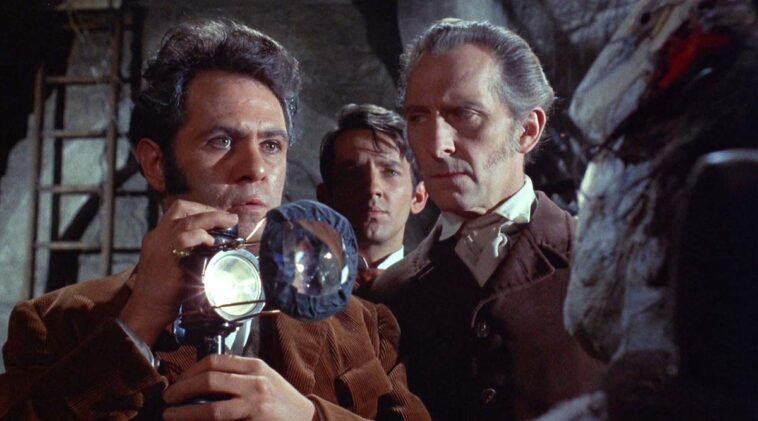
By 1964, Hammer Films stood at a crossroads. The great Gothic cathedral they had built—of blood, faith, and moral dread—was showing its cracks. Dracula and Frankenstein had already carved their myths deep into British cinematic history, terrifying and scandalizing audiences across the globe. Yet the hunger for more persisted. The world demanded another resurrection, another sermon in scarlet, less out of belief and more out of consumer habit.
So Hammer obliged—but this time, something fundamental had changed. The sheer necessity of the original vision had curdled into obligation.
The Evil of Frankenstein arrived not as a seamless continuation of Terence Fisher’s austere, theological vision, but as a strange, self-conscious hybrid: part sequel, part soft reboot, and a heavy-handed homage to the Universal legacy that had birthed the entire mythology thirty years prior. It was a film made not in the cold, challenging shadow of The Curse of Frankenstein (1957) or the vicious intimacy of The Revenge of Frankenstein (1958), but in the nostalgic, backward-looking glow of Universal’s collaborative B-pictures like Frankenstein Meets the Wolf Man and Son of Frankenstein. It was a film that looked backward for guidance, not inward for philosophical truth.
The result is both fascinating and profoundly fractured: Hammer’s Gothic reborn through the lens of calculated nostalgia, and robbed, at least partly, of its revolutionary, spiritual soul. It marks the moment where the studio shifted from creators of dangerous myth to curators of an established brand.
A Return to the Laboratory: The Weariness of the Acolyte
From its opening moments, framed by a startling sequence of the creature accidentally exposing the Baron’s latest experiment to the horrified public, it’s clear that this Frankenstein is not the same one who played God with such ruthless, controlled arrogance in Fisher’s world. The public exposure is immediate and humiliating, signaling a loss of control the earlier Baron would never have suffered.
Peter Cushing returns as Baron Victor Frankenstein, but his tone has fundamentally shifted. Gone is the cold, aristocratic arrogance of the early films—that priest of science who dissected morality as ruthlessly as he did corpses. That man was a true villain, a magnificent egoist who believed his intellect transcended ethics. In his place stands a man wearier, angrier, more desperate—a fugitive running from the consequences of his ambition rather than dictating them.
When the film begins, he and his loyal, if slightly useless, assistant Hans (Sandor Elès) are exiled once again, living like impoverished vagrants on the fringes of civilization, funding their work with small-time carnival tricks and desperate confidence games. Frankenstein, stripped of title and dignity, is a fugitive of both law and reason. Yet his pride still burns, an incandescent core of obsession with resurrection undimmed by failure or exile.
There’s a wonderful, almost pitiable weariness in Cushing’s performance here—a fragility and brittleness beneath the elegant veneer. His Baron is no longer the confident, visionary creator of The Curse of Frankenstein; he’s a man perpetually haunted by his own myth, a prisoner of his own past glories. The line between genius and delusion, once so carefully drawn and defended, now blurs into a manic instability.
When he decides to return to his ancestral home in Karlstaad, he’s not seeking discovery or further scientific breakthrough. He’s seeking the one thing a fugitive cannot buy: vindication. He needs to reclaim his standing, his name, and his greatest work, which the town burgomaster confiscated years ago. This desire for social redemption, rather than intellectual pursuit, is the film’s first clue that the Baron’s spiritual ambition has been downgraded to mere social and professional ego. He’s no longer playing God; he’s trying to win back a title.
The Universal Ghost: Spectacle Over Sacrament
Hammer’s partnership with Universal-International on this film was the elephant in the gothic room, a necessary commercial evil. It gave them the right to use certain visual trademarks long denied by legal obligation: the iconic, misty castle exterior, the elaborate, buzzing electrical laboratory, and most importantly, the square-headed creature itself.
And so, The Evil of Frankenstein becomes, in part, an act of explicit homage—or perhaps an act of commercial exorcism, shedding the burden of being “the other” Frankenstein film. Bernard Robinson’s production design evokes the old Universal aesthetic with loving, almost reverent precision: towering Tesla coils, thick chains, flickering arc lamps, and lightning bolts rendered not as scientific tools, but as sacred machinery of mad science.
But in embracing those famous trappings, the film sacrifices something vital. Fisher’s earlier Frankenstein films were defined by their moral intimacy—the horror was spiritual, the violence was personal, and the laboratory was never spectacle; it was a cold, secular church where the Baron performed a sacrilegious sacrament.
Here, under Freddie Francis’s direction, it becomes spectacular theatre. Grand, colorful, even lushly lit, but often dramatically hollow. The Universal monster—played here by the physically imposing Kiwi Kingston—lumbers through the film less as a tragic being and more as an echo, a memory resurrected without necessary meaning. His face is a massive, silent mask of borrowed history, sadly devoid of the pained existential anguish that made Christopher Lee’s original creature so unforgettable and tragic.
In a profound sense, that emptiness becomes the entire point of the film’s self-analysis. The monster here is a relic of cinema itself—a walking corpse of pure nostalgia, a reminder of the genre’s golden age that Hammer initially set out to brutally dissect. The Evil of Frankenstein is the first Hammer film to feel haunted not by the dead, but deliberately by its own, and its genre’s, past. The lack of genuine tragedy in the creature’s fate is proportional to the lack of genuine spiritual inquiry in the Baron’s actions.
The Baron and the Hypnotist: The Corruption of Vocation
The film’s most intriguing and thematically resonant addition is Zoltan (Peter Woodthorpe), a scruffy, opportunistic carnival hypnotist who becomes Frankenstein’s unholy, necessary collaborator. It is through Zoltan’s strange, mesmeric influence that the creature is reanimated (since the Baron’s initial electric jolt failed to restore brain function), and through Zoltan’s greedy manipulation that the creature is weaponized—a literal puppet of another man’s cynical will.
Zoltan is greed, cynicism, and raw opportunism incarnate. He represents the stark corruption of pure science by cheap showmanship, of genuine discovery by vulgar spectacle. He demands financial recognition for his involvement, forcing the Baron into a commercial contract to share the monster’s “revenues.”
There’s an unsettling meta quality here that is impossible to ignore: Zoltan using Frankenstein’s creation for cheap public thrills directly mirrors the film itself, using the Frankenstein myth for obvious commercial revival and box office appeal. The hypnotist’s exploitation of the creature becomes a direct reflection of Hammer’s own exploitation of its foundational legend. The artistry has been handed over to the marketing department.
In Fisher’s films, Frankenstein sought impossible, divine knowledge—the secret of life itself. In Francis’s film, he simply wants recognition and wealth, allowing Zoltan to parade the monster around like a grotesque street performer. The monster no longer mirrors the Baron’s sin or his soul, but merely his professional failure and the tragic collapse of his high ambition into petty commerce. Zoltan is the necessary parasitic agent who delivers the goods, but at the cost of the Baron’s last shred of ethical dignity.
The Hammer That Hesitates: Visual Grandeur, Narrative Drift
Freddie Francis, a superb, Oscar-winning cinematographer (Sons and Lovers, The Innocents) turned director, approaches the material with undeniable visual flair but uncertain conviction in the underlying horror. Having shot The Curse of Frankenstein, he knew the landscape, but he struggled to capture the theology.
His lighting is lush—a true cinematic feast. The sets are bathed in operatic color, especially the lurid blues and reds of the laboratory scenes, creating a hypnotic, surreal atmosphere. Yet, his pacing frequently drifts. The opening half-hour is filled with extraneous padding—chases through the woods, scenes establishing the carnival’s low-rent atmosphere—that Fisher would have cut with surgical precision.
Fisher’s Gothic pulse, that relentless, theological heartbeat of faith and damnation, is largely missing. In its place lies something more pedestrian: a gothic adventure story with flashes of genuine visual grandeur.
Even so, there are moments when the old power flickers back to life, mostly centered on the magnificent ego of Cushing. The scene where Frankenstein confronts the Burgomaster and his lackey, reclaiming his confiscated treasures, brims with venom and pure class resentment. “You stole from me,” he spits, his aristocratic pride burning through the dust of exile and his temporary poverty.
For a moment, the old, towering Baron returns—not as a mere man of science, but as a wounded god demanding tribute from unworthy mortals. Then the film retreats again, back into the safer territory of Universal pastiche and simple monster movie mechanics, unable to sustain the acidic moral inquiry the earlier films thrived on.
The Creature Without a Soul: Repetition and Ritual
Kiwi Kingston’s creature is an imposing figure—tall, massively scarred, bound in cold metal and leather straps. Yet there’s tragically little of the pathos that made Christopher Lee’s original monster unforgettable in The Curse of Frankenstein.
In Fisher’s hands, the creature was tragic because it reflected its maker’s sin—a being of pure innocence made monstrous by the corruption of intellect and the flaw in its design. Here, it is reduced to pure function: a brute, a victim of hypnosis, and a tool of narrative inertia. Kingston’s performance, constrained by the familiar mask and the hypnotist’s control, lacks agency.
Its inevitable rampage feels obligatory, not truly inevitable—a necessary plot beat rather than a philosophical climax. Even its death lacks the apocalyptic, sublime poetry of earlier Hammer finales.
And yet, within that very hollowness lies a strange, resonant poignancy. The monster, like Hammer itself, is repeating gestures whose original meaning has been diluted, if not lost entirely. Its violence feels less like organic rage and more like ritual, its destruction like unthinking repetition.
The Evil of Frankenstein becomes, perhaps unintentionally, a profound film about the death of meaning—about what happens when myth becomes brand, when spiritual inquiry is replaced by commercial formula. The true horror isn’t the monster; it’s the realization that the old terror can no longer shock, only satisfy a known expectation.
A Mirror of Decline: The Socio-Cinematic Context of 1964
To understand The Evil of Frankenstein properly, one must see it as a reflection of its exact moment in time.
By 1964, Hammer was no longer the rebellious, shocking outsider of the late 1950s. The cinematic landscape had moved on dramatically: continental horror was pushing boundaries, and the domestic market was demanding newer, more contemporary forms of terror. The gothic shock had faded; the blood no longer guaranteed scandal; the moralizing Church no longer protested with enough volume to generate free publicity. What had once been dangerous was becoming safe and familiar.
So the studio turned inward, rummaging through its own tomb for marketable relics. The result was this—a film about resurrection that feels exactly like disinterment. It is a financial calculation, an attempt to stabilize the brand by aligning it with the universally accepted, comfortable imagery of the 1930s Frankenstein films.
Yet there’s beauty in that sheer desperation. The Evil of Frankenstein may lack Fisher’s metaphysical weight, but it pulses with a tragic, self-aware nostalgia. It’s the studio confronting its own decay, trying to rekindle the fire that once genuinely terrified the world, using the very aesthetic it once sought to replace.
The irony is exquisite: the studio that made resurrection its definitive art form now clearly needed resurrection itself. They didn’t just tell the story of a man obsessed with reviving the dead; they were living it, betting the farm on the power of a borrowed ghost.
The Color of Memory: Francis’s Visual Elegy
Even in its unevenness, the film remains visually striking. Francis, a master of atmosphere and light, bathes the sets in operatic color—a palette of dying grandeur. The cold, forbidding grey stone of the castle contrasts sharply with the lurid warmth of firelight and the metallic, electric blues of the laboratory. It hums like a magnificent machine dreaming of the God it failed to create.
Don Banks’s score, too, adds a profound layer of melancholy. It is sweeping, mournful, and occasionally bombastic—but unlike the urgent scores of the earlier films, this one feels like an elegy for Hammer’s innocence, as though the music itself knows the genuine magic is irrevocably fading.
There’s a particularly haunting moment near the end: the creature, lost and blind with rage after Zoltan’s final command, staggers through the ice tunnels of Frankenstein’s laboratory, destroyed by its own creator’s final failure to protect it. The sound echoes hollowly, like footsteps in an empty, sacred cathedral. The image is beautiful, pitiful, and terrifying—Hammer Gothic momentarily reduced to silence and frozen ruin. It is a moment of pure visual poetry achieved despite the narrative shortcomings.
The Baron’s Last Confession: The Artist Refusing Extinction
Cushing holds the film together through sheer, unrelenting conviction. His precision and gravity lend weight to every single line, even when the script—rewritten by Anthony Hinds under the pseudonym John Elder—falters into melodrama. He never plays the failure; he plays the persecuted genius.
He is the cry of the artist refusing extinction, the scientist defying meaninglessness, the studio clinging to its own mythology even as the world moves on. It’s Cushing, the veteran, delivering the definitive stance of defiance for the entire Hammer philosophy. He is portraying not just Frankenstein, but the doomed artist who must create, even if the creation is flawed, because the alternative is to cease existing entirely.
Final Thought: The Echo of Creation
The Evil of Frankenstein is definitively not one of Hammer’s masterpieces—it lacks the purity of The Curse and the vicious wit of The Revenge. But it is, without question, one of its most brutally revealing films.
It exposes the agonizing tension between artistic faith and commercial formula, between the conviction of its original creators and the necessity of brand maintenance. It shows what happens when the Gothic church becomes a museum, its icons dusted off for exhibition rather than spiritual worship. The film is a commercial necessity dressed up in the clothes of a tragedy.
And yet, even in its compromise, it carries the undeniable pulse of life. The same defiance that drove Fisher’s Baron still beats beneath its surface: the refusal to die, the obsessive need to create, the hunger to play God one more time, no matter how imperfectly.
The film’s final image—flames and ice devouring one another in the ruins of the laboratory—feels like a perfect metaphor for Hammer itself: beauty and ruin intertwined, burning and freezing in the same breath.
Because in the end, The Evil of Frankenstein is less about science gone mad than about art refusing to die. It is Hammer resurrecting itself, however imperfectly, one last time while the new, contemporary horrors of the 1960s swept in to change the genre forever.
It is the echo of creation—faint, flawed, commercially motivated, but still beating with the magnificent, desperate heartbeat of Victor Frankenstein himself.
