Aaron Jones
Resident Evil: Where Horror Begins
Resident Evil is a series that needs little introduction. For nearly 30 years the Resident Evil franchise has been setting the standard for horror in gaming. With viral zombies, sentient mold, and head exploding parasites, the series has continued to give players excitement, terror, and spectacles untold. Nine games make up the main series with a 10th ready to hit the shelves, in time for the 30th anniversary of the original. These ten games also don’t count the multitude of spinoff and remake titles. With over 30 titles, 50 if you count mobile games, there is truly something for any player to enjoy.
To know the impact Resident Evil has had on horror gaming, and the wider video game industry, we need to go back to 1996 and enter the world of survival horror for the first time.

(Spoiler warning for Resident Evil 1996 and 2002.)
The Look of Fear
With so many years and so many games, it is easy to forget how truly revolutionary the original Resident Evil was. Looking back now, with our eyes spoiled by 4K and mobile efforts larger than the NES library, it is easy to say that it is bad looking. When Resident Evil first came out though, it was praised for how “lifelike” and “revolutionary” it was. Using pre-rendered backgrounds and fixed cameras with 3D character models moving over them, it was able to put more detail than ever in the environments the players would explore. This is one reason that the Spencer Mansion is remembered as such an iconic gaming location.
When traversing the Spencer Mansion the player will discover the evil corporate plot to create viruses and monsters, but this is not the only story we will uncover. We find many files and diaries belonging to the staff that took up residence in the mansion. These diaries paint a vivid picture of the slow, horrifying deaths that took the now zombified workers. The same zombified workers that are waiting outside to eat you alive.
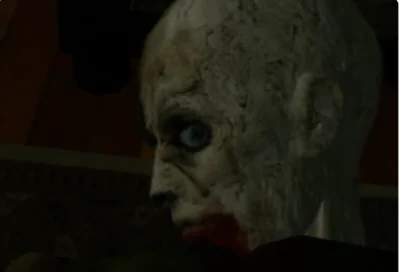
These notes along with the smaller details the game could add with the pre-rendered backgrounds, the mansion starts to come to life. Showing small things like footprints and stains helps unfold the mystery of what happened here and what these monsters are. The Spencer Mansion begins to feel like a character and an enemy. It starts as just a mysterious home in the forest, a place to flee from monsters chasing you and your team. As you explore it becomes a literal house of horrors. With zombies and other mutated creatures roaming the halls, already the danger is high. This danger is made worse by the sheer mass of puzzles the Spencer Mansion has to offer, many that can lead to instant death. All requiring some specialized key, crank, or crest. And all of these items need to be carried with you.
Managing the Items of Fear
A major struggle for you in Resident Evil is resource management, with a limited inventory cut down to only 6 or 8 item slots, depending on character choice. This is an issue that you will face the entire game. You will constantly be asking yourself, “should I bring extra ammo?” “Do I need this key?” “I don’t need this health item do I?” “Will I need more than one space to pick something up?”
You’ll be asking yourself these questions and more as you make your way through the Spencer Mansion and its grounds. Constantly teetering on the edge of failure if you brought the wrong items. Thankfully the game gives you the helping hand of the Item Box in the game’s strategically placed Safe Rooms. These rooms are used to store items and save the game, yet even saving isn’t safe from the stress of item management.
Safety from Fear
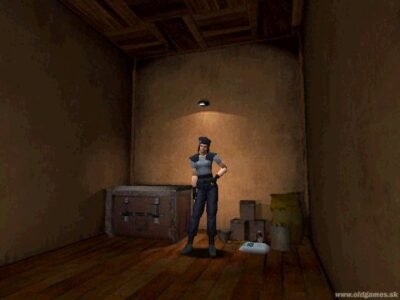
Ink Ribbons can be used to save your progress in the game at Typewriters scattered around in the Safe Rooms. Each time you save the game an Ink Ribbon is used up, leaving your inventory never to be seen again. Thankfully saving is done in a Safe Room, a room containing a Typewriter, Item Box, and a calming music track.
These rooms not only offer you a chance to save the game and organize your items, they are a safe haven from the monsters roaming the halls. Once you hear that calming music start to play you are given a relief. At that moment you know you can take the time to feel safe, to heal yourself, and to plan your route through the mansion. The dangers may still be on the other side of that door, but as long as that music is playing, you are safe. Eventually you will have to leave the safety of the Safe Room, to leave your extra items in the box, and explore the dangerous halls of the Spencer Mansion.
Fighting Your Fears
The early Resident Evil games famously used fixed camera angles and infamous tank controls. Though both elements have been criticized and memed to death, they help build the game’s atmosphere of helplessness adding difficulty and intention to your combat. Most games let you move and avoid enemies while fighting, this is not the case with Resident Evil.
When you defend yourself from the many creatures of the mansion, you don’t get to run and gun like an action man. You plant your feet, raise your weapon, and take aim, only being able to pivot while doing so. This makes you take your time and to think about combat, questioning your spacing and the speed of the monsters. This only builds the helplessness you will feel while you explore. It will also teach you that sometimes running is much better than fighting.
The Story of Horror
The story of Resident Evil is a basic one, being the same as Predator or the more recent Abigail. The group of expert badasses are sent in to take on what should be a simple job only to be met by something that starts killing them one by one.

S.T.A.R.S. (Special Tactics and Rescue Services), a S.W.A.T. like group from the Raccoon City Police is investigating recent “bizarre” murders that have been taking place in the city; the victims appear to have been eaten. With some form of never explained evidence, the forest around the city has been linked to the attackers. After the literal B Team (Bravo Team) didn’t check in, the Alpha Team of S.T.A.R.S. is sent to find their lost teammates and hunt down the crazed killers.
This is a basic plot used in many forms of media. I’m sure you’ve seen a movie with this same kind of plot, such as the aforementioned Predator. The base story of Resident Evil isn’t complicated, but the best horror is normally simple. For Resident Evil this simplicity brings freedom for the environment to be the main push for horror, but the story doesn’t let you down once you reach the end.
The game gives you the choice between Chris Redfield and Jill Valentine, what seems to be the standard boy/girl character selection, but holds much more weight. It’s not just a decision between genders, but it is also a choice between difficulties and story progression.
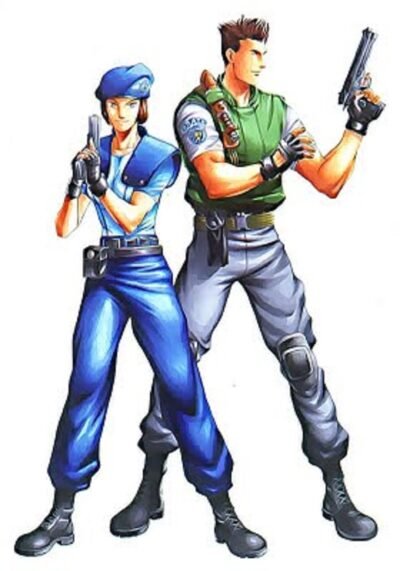
Jill starts the game in the Mansion with Albert Wesker (The leader of S.T.A.R.S.) and Barry Burton (a father and senior member of S.T.A.R.S.), as the surviving members of the team, we don’t know where Chris is at the moment. Jill starts with a lot of help, though Barry and Wesker don’t join your exploration through the mansion, Barry will provide you with ammo, health left in safe rooms, and will literally save your life while delivering one of the best lines in video games:
You were almost a Jill sandwich.”
Chris has a much different path through the mansion. Starting with Jill and Wesker, and having no idea where Barry is, you’d think Chris would have the same amount of help, but no. Jill and Wesker go missing shortly into the game leaving Chris alone for quite some time before finding his partner character, Rebecca Chambers (the rookie of Bravo Team on her first mission).
Rebecca offers some help, even having sections of being a playable character, something Barry doesn’t get until a forgotten Gameboy spin-off and a much later regrettable spin-off title. The Partners offer help and quick cutscenes to progress the plot, but like usual with Resident Evil, the real difficulty between characters is the difficulty of item management.
With item management being such a big obstacle in the game, inventory slots matter a lot, and this is why many players consider Jill to be easier. Jill has 8 item slots, Chris only has 6. Can two item slots really make a difference? Yes, they absolutely can. With 8 spaces Jill has much more freedom than Chris to explore the mansion or make mistakes, as an extra health item can easily be carried.
Jill also has more advantages over Chris. Chris only starts the game with a knife, having dropped his gun in the woods while fleeing from zombie dogs to the mansion, and he won’t get a gun until Jill and Wesker disappear. Chris is stuck with a knife, known for being all but useless, while Jill starts with a pistol already equipped, and receives a grenade launcher that Chris will never find. Along with the weapons, she will also have a lock pick that lets her open special locks, something Chris will need to find keys for. None of these differences really change the overall story very much, information may be stated differently or found at a different time, but both characters will uncover the origins of the mansion.
What was it that caused zombies and monsters to roam the halls of a forgotten mansion and the surrounding forest? Was it the Devil? No, just plain old corporate greed. Something that simple and that common. Umbrella, the fictional pharmaceutical company that has cornered the market on home health products, is actually a front for bioweapons research. A later moment in the game lets you flip through the slides of a board room in the secret lab. Suddenly the monsters that have been hounding you this entire game, are named and quantified for value. The dogs you watched eat your friend, they have been named Cerberus and are planned for military use. The virus turning healthy people into flesh eating zombies, well that’s just the T-Virus.
Greed is even the big twist of the game. Near the end both Chris and Jill will discover that Captain Albert Wesker has betrayed the S.T.A.R.S. He sent in the Bravo Team not to investigate, but to be killed by the monsters of the mansion. All to collect “Combat Data” on each of the creatures and sell that data to an unknown rival company of Umbrella.
Greed is the monster of Resident Evil. Greed got several townspeople, the staff of the Spencer Mansion, all but one member of Bravo Team, and depending on choice, at least one member of Alpha Team killed. Greed is why corners were cut and why the T-Virus was able to slip out and infect the staff. Greed is even what gets Albert Wesker killed, for now.
At the end of the game, Wesker, in search of the highest paying monster data, unleashes the Tyrant. A brilliantly designed monster, featuring massive claws, an exposed heart, but just enough human features to make it also unsettling. The Tyrant on being released, stabs through Wesker and leaves him presumably dead on the floor, leaving you with a monster to face.
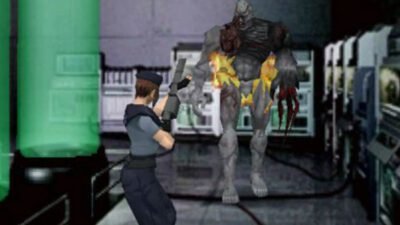
The battle finally concludes on a helipad, with the escape helicopter hovering just above. But the creature isn’t the only threat to this fight; you are also on the clock. Depending on your choices, a self destruct to the Mansion can be triggered, giving you a short amount of time to get to safety. This will become a long running staple of the series. As you reach what you think is finally safety, the Tyrant literally breaks through the ground for one last fight.
This last fight, one final round with the biggest and meanest monster of the mansion, but your surviving partner characters will try to help you. Once you’ve done a small amount of damage to the Tyrant, a special end of game Rocket Launcher will be dropped from the rescue helicopter, yet another long lasting troupe that will follow the series. This isn’t really a weapon though, sure it may kill the Tyrant for you, but this is a celebration. One big firework in your honor for beating the game, for surviving the horror of the night, and it is a satisfying firework to set off, leaving the Tyrant in chunks along the helipad, and ushering you to safety.
The Legacy of Horror
Resident Evil was a smash hit, instantly having players asking for more, and the video game industry heard that call. Many horror games have borrowed elements from Resident Evil, the fixed camera angles was an idea that really took hold of the industry. Another was item management, though not originally from Resident Evil, its masterful use in the game made it a standard part of horror gaming even to this day.
Maybe the most well known thing about the first game is the voice acting. Though the game sets an atmosphere of terror, the voice acting brings the atmosphere of a drunken community theater production. The American “actors” were just Americans that were living in Japan, none of them being professional actors at the time. This one misstep doesn’t take away from the game, almost adding to its charm. When Barry proudly holds up his massive Colt Python and says:
don’t worry, I’ve got this.”
You almost can’t help but smile at the B-movie quality.
With corny voice acting, dripping atmosphere, and a simple but memorable story, Resident Evil took the crown of horror gaming, a crown it has had a grip on for 30 years. The original Resident Evil changed gaming and inspired a whole new genre called Survival Horror, a term originating from a translation error at the beginning of the game, but one that sums up the idea of this and many future Resident Evil titles, and many games to follow in Residents Evil’s footsteps. Resident Evil truly changed gaming forever, and with a new game appearing soon, it may continue to change gaming yet again.
A Lesson in Horror
What morals or deep meaning can be placed on Resident Evil? Really, not much, but I doubt many players tried the game for moral guidance. The characters are fun enough to be memorable, but enough of a blank canvas that you yourself feel like you are going through this horror. However, I think the major take away is the evil of corporate greed.
Umbrella designed and bred these monsters for war. Selling bioweapons to the highest bidder just for profit, and though this is partly retconned in later titles, this is really the only real lesson we can take from it. Unlike Wall Street’s Gordon Gecko, Resident Evil does not think greed is good, but suggests that a company like this must be stopped. Something I hope we all could agree to when speaking on bioweapons.
It’s a simple message, and one I’m not sure was even intended to begin with, as the game itself never speaks to this idea. It’s the subtext of the environment and B-movie plot the game created. The evil corporate entity cutting corners and being up to no good was a popular plot of the late 80s and all of the 90s and may have been just an easy way to wrap up a simple storyline.
All that being said, the only other lesson that could be taken is perseverance. The Spencer Mansion may take you several tries the first time through, many times you may even run out of the limited ammunition scattered around the mansion. With the many tries the mansion may take you, the sense of accomplishment when you finish is well earned.
Personal Horror

Resident Evil is, what younger “hip” people call, a “core memory” for me, and I like to share the type of terror it inspired in me as a child. I’m not sure of the year or my actual age, but I was still rather young, being only around 8 or 9. My brother, on the other hand, is 8 years older than me, so at the time I was just the annoying little brother.
My brother was having friends from high school over to spend the night, and none of these high schoolers wanted a little kid running around bugging them, so my brother bribed me. He let me know that his friend was bringing over his new PlayStation and all his games, and if I left them alone for the night, I could play it all morning the next day. This was an opportunity I couldn’t turn down, so I hid in my room all night waiting to try the new fancy games.
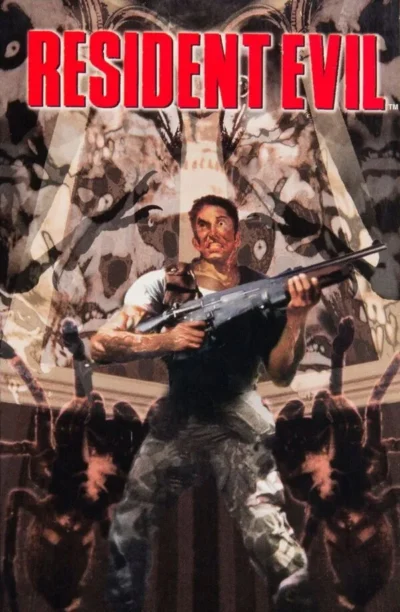
The next morning I woke up early and ran downstairs to play the new teenager games. I don’t remember all the games I tried that day, but none were really standing out to me. That’s when I found Resident Evil. The cover made it seem like an action game, with a buff soldier type surrounded by what looked like giant spiders. This looked fun, I could definitely shoot spiders with a big gun.
I placed the disc in the system and powered it on. I selected Jill because I thought she was interesting, a sign of puberty waiting around the corner for me. I sat through the live action cutscene that begins the game, thinking it was a little spooky, but probably still a big action romp. This lasted until I saw the first zombie reveal, after that I was uneasy and a little afraid. The feeling kept building until I encountered one of the most famous jump scares in gaming history. As the zombie dogs broke through the window and started to attack, the fear finally took hold. I screamed, threw the controller at the screen, and crawled across the living room floor to turn the system off, waking everyone in the house.
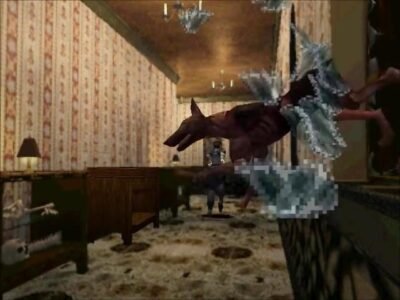
I had never seen horror in a game before, I didn’t know a video game could make me afraid. Video games at that point to me were Mario or the Ninja Turtles, not zombie dogs and severed hands. This could have been something to turn me off of the series forever, but my brother didn’t let that happen. Seeing me afraid, he thought knowing the good ending would make me feel better. He somehow blackmailed his friend into playing the entire Jill side of the story for me, letting myself and my now awake mother watch the entire story. Everything played out right in front of me, from hallway dogs to the glorious explosion leaving the Tyrant in a mess.
This memory stuck with me and birthed an obsession with the Resident Evil games that lasts to this day. Since that early morning in my childhood home I have played the original Resident Evil in some form hundreds of times, always being reminded of that early morning, the pretty lady with a beret(Jill), and an older brother that didn’t want his little brother to be afraid.
Thank you for reading.