Jean Jentilet
From the moment in Saw when Lawrence Gordon posits the morally and legally ridiculous notion that the Jigsaw Killer never actually kills anyone since all of the traps he sets have a way out, the devolution of the Jigsaw ethos is inevitable, and assures the audience that the only constant to be expected from John Kramer and his various apprentices is a deep moral arrogance. The position becomes more fantastical as the connection between each victim’s predicament and their supposed sin becomes increasingly tenuous. Jigsaw becomes nothing but a particularly capricious deity. The requirements of maintaining a franchise compromised the premise even further; the decision to meet those requirements with an emphasis on progressively convoluted timelines rather than developing more fully the potential of the idea behind each apprentice acting with their own motives makes a bloody mess only worsened by prequels and sidesteps.
It’s easy to view these things in the context of a structured morality that would be recognizable to most people: none of Jigsaw’s victims deserve their fates. At the same time, each individual movie demands that we take Jigsaw(s) at their word as to the worldview and motivations (presented to the audience, not necessarily those being tested). The innocent lives put at risk as bait or collateral damage are separate from the games, and not subjected to Jigsaw’s assessment; their suffering is outside of Jigsaw’s moral calculus. So this isn’t about the children and spouses and employees used to measure the will of their parents or partners to live; it is about those not innocent, and whether, assuming the correctness of Jigsaw’s worldview, they got what they deserved.
Saw – Adam: No one wants to work these days.
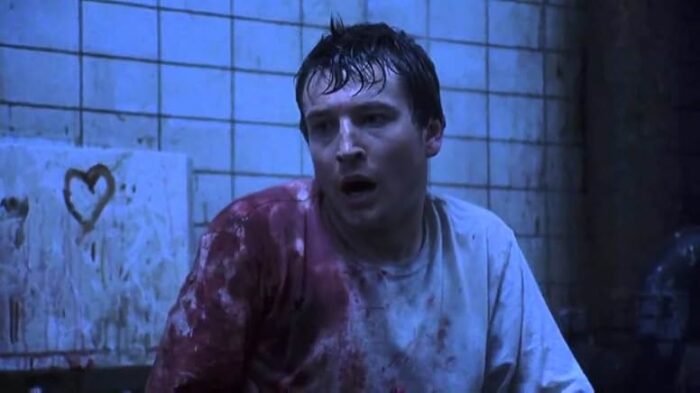
Maybe Zep Hindler, who seems to have been too creepy and off-putting even for Jigsaw, could go here, but we are not given enough information in the movie to make that determination. We know that Adam was not simply part of Lawrence’s test, because Jigsaw told us. And his great sin: doing his job. He is paid to follow people (cheating spouses, finagling business partners, etc.) and take pictures. (Not a particularly noble calling, but it’s a wonder that a narcissistic voyeur like Jigsaw doesn’t harbor some secret admiration for Adam.)
No amount of making Adam a victim of Amanda’s insecurities or bad planning changes this. If Adam had been meant to wander the bathroom while Lawrence stayed chained up, it makes no sense to chain Adam up in the first place. Aggravating this is that Adam has one of the worst fates in the series: trapped alone in the dark with a fresh corpse, and believing that no help is coming. Throughout the franchise, we will meet dozens of people for whom this might have been appropriate, but it’s not the photog just trying to make rent. Amanda, Lawrence, and Paul were all, to use Jigsaw’s term, ungrateful for their lives. Billy does not let us forget this. But Adam was literally just doing his job, and judging by the state of his apartment, he probably didn’t have a lot to be grateful for, anyway.
Saw II – (Tie) Jonas and Addison: No good deed goes unpunished.
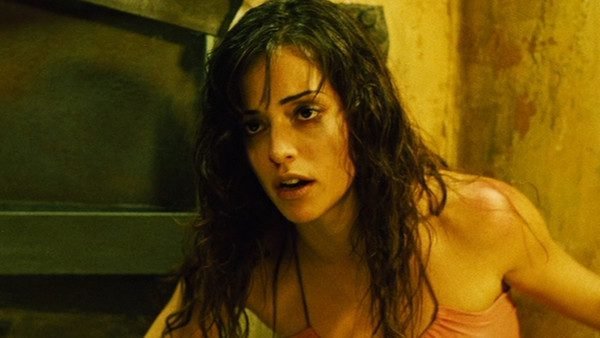
Ignoring the plant (Amanda) and the bait (Daniel), we are left with a group of pedestrian petty criminals. Over the course of the movie, drug dealer Xavier gives Jigsaw more justification than we have seen him use to play games for almost anyone else in the entire franchise, no matter what the stated reason for Xavier’s test. It’s hard to drum up sympathy for Obi, who helped wrangle the other players, and whoe seems like a second run at justifying Zep’s test in the first movie as someone who got caught on the back foot but revels too much in the treachery that their position as a temporary bagman for Jigsaw requires. Laura, while not as odious as Xavier or Obi, could be seen to be acting gratuitously: a thief, but not for survival. Based on the information available in II, Gus might have not deserved his fate, but later revelations about his role in Jill Tuck’s miscarriage put him firmly in Jigsaw’s revenge basket, while being a great example of how the choice to construct the franchise like the Lorentz factor takes a bite out of its narrative effectiveness.
So, who’s left? Jonas, who seems like he might just be in witness protection, which suggests that he is already undergoing a possible redemption arc; and Addison who, like Adam, is just trying to get by. In typical Saw fashion of nested tests, they both fit into Eric’s test, but Jigsaw has made traps for them specifically. What is the point, then, of their trials? What lessons were meant to be learned? That contrition is pointless unless it’s under the threat of death? We don’t know. We’ll never know.
Saw III – Jeff: Pots to the left of me, kettles to the right.
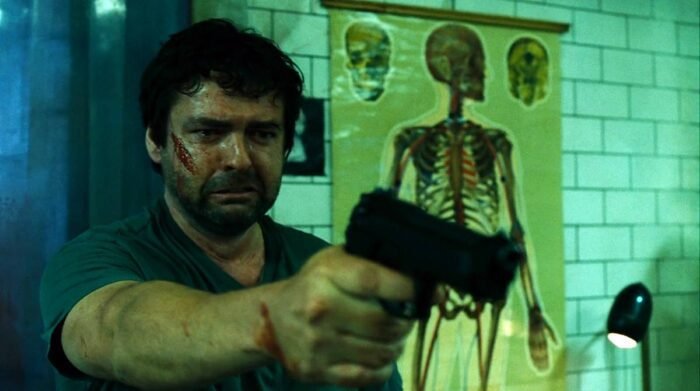
While Lynn certainly didn’t deserve her fate (one the most darkly clever and garishly effective for a non-player) using real world morality, Jigsaw again makes no attempt to justify what happens to Lynn as a judgment, as she is useful to him outside of the game. We, the audience, see her being a little mopey before her capture, but this isn’t Jigsaw’s motive. Every person actually inside Jeff’s test has clear, definable guilt, and the gestures towards poetic justice with the symbolism of the traps are solid: freezing, choking on filth, fatally contorted limbs. But the justification for putting Jeff to the test at all might be the point of no return, the moment when Jigsaw goes from twisted life coach to mad god. Demanding perfect grief unmarred by a desire for revenge (however abstract) from a father who lost his child to a drunk driver is mighty rich coming from a man who has orchestrated the deaths of dozens because of the actions of a careless addict years prior, but here we are.
Saw IV – Rigg: Just stop being human. It is distasteful. To me.
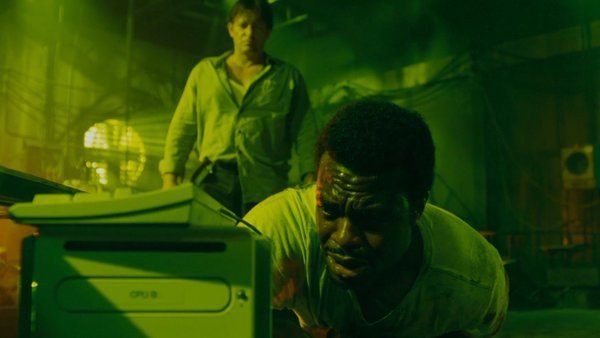
Just as Obi feels like a second run at Zep, Saw IV feels like a second run at Saw III, with Rigg in the Jeff spot as the primary player served up a platter of deserving guilty, and Eric Matthews in the Lynn spot as bait. The tweaks to what is otherwise pretty bald “second verse, same as the first” storytelling provide more palatable in-world justifications. Eric Matthews has racked up his own substantial list of sins. Everyone in between (except Morgan) is explicitly more irredeemable than any of the guilty in III who were mostly just cowardly and weak. Even Art Blake, who is just doing his job as a defense lawyer, is doing it in the worse possible way, and appealing to some base passions in an audience that also hate lawyers. Though Rigg rushing into situations puts multiple lives at risk (as opposed to Jeff’s solitary grief and absentee fatherisms that therapy might fix), given who is surrounded by, it’s as comfortable to say he is the least deserving of his fate as it is to say the same about Jeff.
Saw V – Brit: No, not like that.
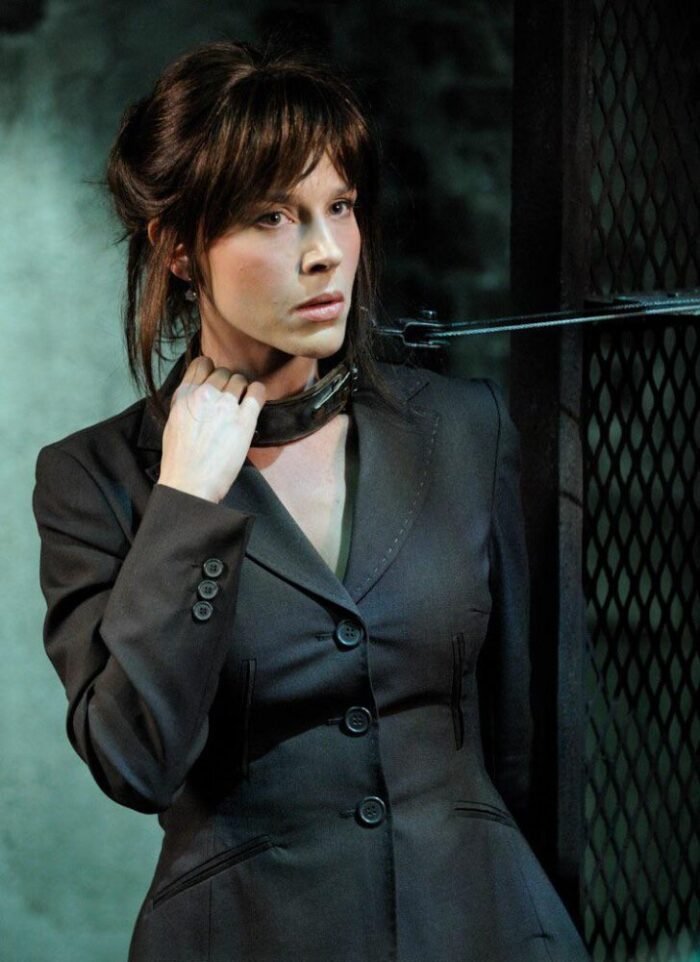
Another ensemble game, but now all the players are complicit in different aspects of the same wrongdoing. While the common crime of the Fatal Five (the execution and cover-up of a fatal fire to clear the way for real estate development) is revealed over the course of the movie, the viewer’s allegiances shift around until it becomes clear that no one is innocent, that if ever Jigsaw had actually seemed to mete out punishment consistently if not justly, it is here. It could be argued that Mallick deserves the game less than any, even as the person who actually started the fatal fire, because unlike his fellow players, his actions out of desperation are different in character than the rest of the Five, who all acted out of calculated greed—none more than Brit, who benefited most from the fire, who engineered the entire scheme from the beginning, and who was the real reason everyone was there.
And yet, Brit survives. We never find out if she learned anything from the ordeal, because the logistics of the game, which required a perverted version of the same teamwork the five used to commit their crime to survive, has no bearing on her actual, individual failings. If anything, one can imagine that Brit will view the ordeal in hindsight as evidence of her rightful place near the top of the food chain, despite apparent remorse in the immediate wake of a life or death struggle. It’s not that Brit was the least deserving of her trap: she was the least deserving of the redemption of escape. And the fact of her success (alongside Mallick’s) is all we really need to know about the arbitrariness of the games and their failure as tools of either rehabilitation or salvation.
Saw VI – (Tie) Addy and Allen, Tara and Brent: Horrible Bosses 3.
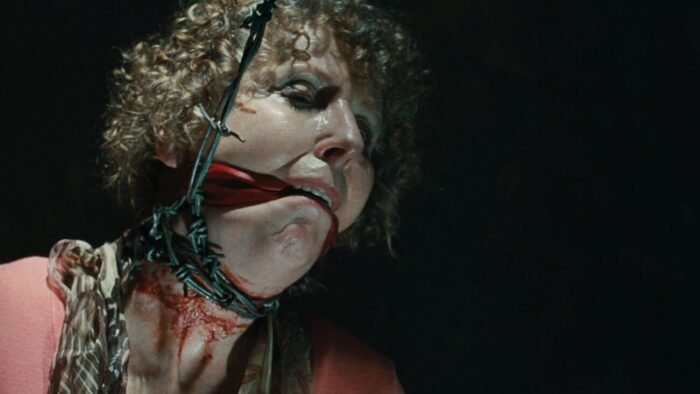
Everyone’s got a job to do. But there’s Rigg acting a little too rashly to save the world, and there’s Adam snapping shots of cheating husbands, then there’s Umbrella Health CEO William Easton and friends denying heart treatment coverage due the pre-existing condition of having a cavity filled thirty years ago.
The other players in William’s game, like those in Jeff’s game, are mostly left to the whims of the main player, and one much less sympathetic than Jeff. Hank, a janitor at Umbrella Health, is one exception to this when his is pitted against William in a test where the loser gets their chest crushed. Realistically, Hank had no chance. A man with a 30-pack year habit and with fifteen years on his competition is going to lose a breath-holding contest, but Jigsaw can perhaps rest his head by telling himself that if Hank really wanted to live, if he really appreciated his life, he wouldn’t have been smoking anyway. It makes classic Jigsaw sense, but it doesn’t have much to do with the rest of the game, and feels undeserved in that way. Others deserved their traps even less.
Easton is in a sort of reverse Jeff situation: whereas Jeff had a reason to want harm to come to everyone in his game, William must choose among people he has no reason to harm. That is not to say that they are innocent, by Jigsaw morality. They are not. But if that morality is creatively circumvented throughout the series, it is stretched into formlessness when William has to choose between killing Addy, his sick, older secretary (who has a family) and Allen, his young and healthy but single file clerk. He chooses to spare his secretary’s life. There the pretense of culpability is simply who is more valuable given the way they live the most mundane aspects of their lives. If nothing else, the Addy and Allen trap solidifies VI as a relatively coherent critique of the state of the American health care system in 2009, with the irony being that in reality, William would have canceled Addy’s coverage first.
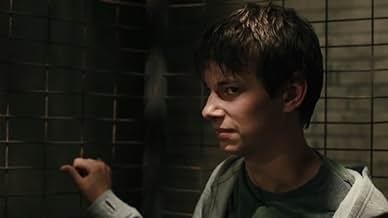
At first blush, it doesn’t seem that Brent and Tara are tested. They have a choice, but there is no downside—or so it would seem. Only when Brent acts on the same impulse for which Jeff was tested do we see the real cost: guilt. It might feel satisfying at first, but the unspoken cruelty here is offering the temptation in the first place to people that would have found better ways of dealing with their grief; it’s the creation of blame that wasn’t there, initiation of the very cycle Jigsaw calls out throughout the franchise. Neither Brent nor Tara deserved to be re-victimized, however abstractly and however noble the intent.
Saw 3D – Not Joyce, actually.
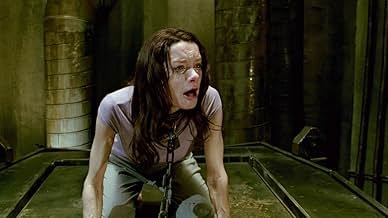
Joyce Dagen does not belong in brazen bull for standing by her man. We have no evidence here that she was aware her husband was stealing the valor of actual Jigsaw victims. She’s just more bait.
But, if we are looking at those with actual guilt by Jigsaw’s reckoning, there is a split: Nina’s trap is divinely retributive and diabolically cruel. It is not just the pain and fear of the trap, but the inability to “speak” about it, to express it. Actual Hell for a PR person. It’s a great metaphor, and wildly out of proportion to the other (non-Joyce) tests. If we’re balancing culpability against “just doing my job,” Suzanne is the least deserving. She enabled Bobby Dagen insofar as any lawyer can be said to enable anything, but then we have to ask what was the real harm done here? In fact, one could argue that Bobby was a net good to the world. His ruse gave people hope and strength. In this sense, it might be argued that he was able to what Jigsaw never could: teach people real gratitude for life.
So maybe…none of them deserved it.
Jigsaw – (Tie) Logan and Anna: Each copy thinner than the one before.
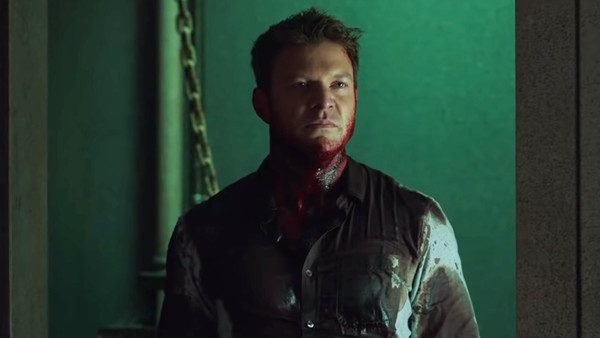
Apprentices come and go, and so do catchphrases. “I speak for the dead” isn’t a great one after years of “Game over.”
Anyway…
Like the Fatal Five from Saw V (which Jigsaw draws from heavily), the game in Jigsaw is full of players that seem to deserve what they get—but some should have gotten more.
Logan, let’s be real, is an unworthy apprentice, and that terrible catchphrase is just more proof. He escaped his initial test because John miscalculated. In a vacuum, that seems fair enough, until one remembers that there are multiple examples throughout the series where the trap just didn’t work right, or was simply impossible, or was more down to luck than will. (This is not counting those times when Amanda or Hoffman made intentionally inescapable traps.) We will see at least two of these in X, but we also saw it in the very first installment with the candle trap. Jigsaw’s mercy is as nonsensical as his cruelty. Logan may have deserved another test, but he didn’t deserve a pass.
As to Anna, a lot of people get tossed into AmanKramHoff’s meat grinder for just the goofiest things, and every player in Jigsaw did something, but I am willing to go out on a limb and say that killing your child and framing your husband all the way to his suicide is a few notches worse than a smack habit or not making the best career choices. Anna got hers in the end, of course, but as Brit’s survival in V is a testament to Jigsaw’s capricious, the fact that lazy mechanic work is punished with the same severity as the cold-blooded double whammy Anna perpetrated is inane.
Spiral – Samuel L. Jackson: We all died a little inside.
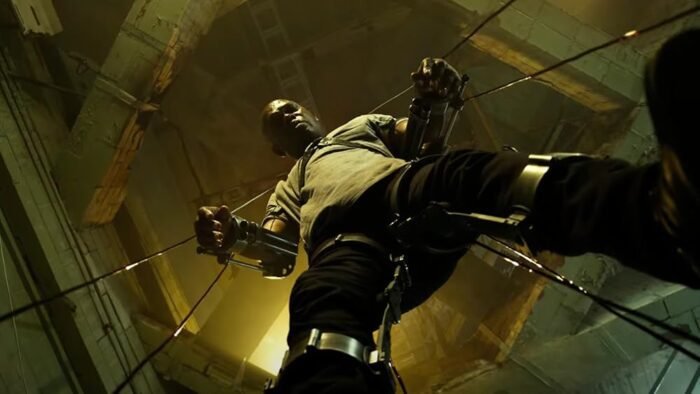
Just because everyone else at your work is doing the worst possible version of your job doesn’t mean you have to follow along.
Spiral asks: What is the trick to getting a Jigsaw-inspired killer with a relatively straightforward motivation? Spiral answers: It seems that maybe not coming into actual contact with John Kramer is the key. No one here is innocent, not even a little, but Garza took the worst for the team. If everyone else’s crimes are relatively equal—and they are—her demise was the most unsettling. Paralysis? Or a hot wax waterboarding? Seriously? That’s not an actual choice.
However, there is one real victim of Spiral, one who truly did not deserve it. The unseriousness of Marv Banks’s demise, which feels like an episode of Thunderbirds produced by a pubescent edgelord, might mean that the trap of Samuel L. Jackson’s contractual obligations to perform this scene was the cruelest of all.
X – (Tie) Carlos, Valentina and Mateo: Did someone say “over-engineering”?
Another ride on the Jeremy Bearimy brings us to X, which occurs between Saw and Saw II. The traps feel very much like John hasn’t perfected his rhythm quite yet, so there’s that.
As to the players, Cecelia wasn’t technically a Jigsaw protégé (again, from what we know from all movies as they actually exist and are viewable to the masses), but she had the fire in her belly, so that should count for something. If it does, then Carlos would be a Jigsaw victim, and would not deserve it in any way, being as he’s a child.
But, let’s work with the world the way it is, and not the way we wish it would be.
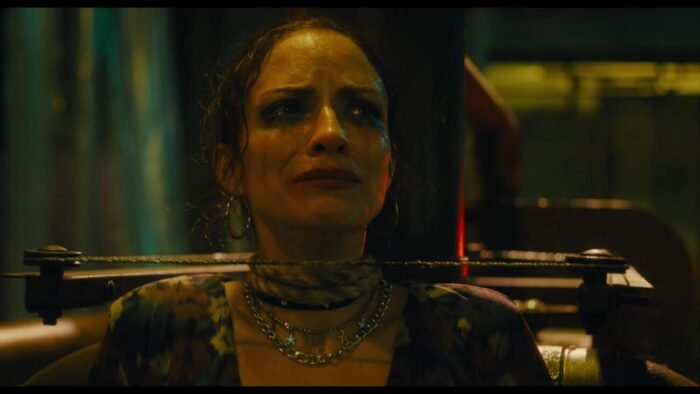
Valentina’s trap was insanity. She’s cut off her leg! What else do you want? Saw traps are essentially always timing issues, but this one is especially egregious not only because Valentina did everything she was asked to do (we’ve seen this before), but because she was asked to do so much. I’m not even sure it’s possible to saw off a leg and extract that much marrow in three minutes. That she ends up being repurposed into a survival cord just adds insult to injury.
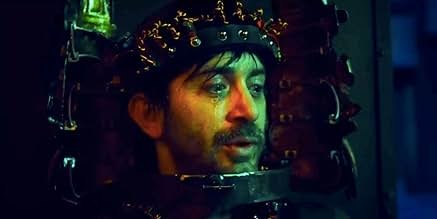
Similarly, Mateo: he Krendlered himself. He did the hard part, but John miscalculated—kind of like he did for Logan, but this time on purpose, and with no swooping in the save Mateo. Mateo just gets to die watching his brain not dissolve.
To the extent that Jigsaw is a bloodthirsty demon disguised as an engineer, the ghoulishness of Valetina’s test make her the least deserving. To the extent that I do not believe that anyone else in the Saw universe could have pulled off what Mateo did, Mateo brings home the gold.
But the X tests weren’t about teaching lessons or testing mettle; these were acts of pure revenge. Jigsaw must have a head-splitting case of cognitive dissonance as he skips to the dot over the ‘i’ and in the very next installment in storyline chronology punishes Jeff for kind of vaguely wanting to do the same thing but lacking the imagination or the PE certification. And worse, the same apprentices (Amanda and Hoffman) who help John with these traps are later subjected to additional tests because of their penchant for using the tests to destroy their enemies.
I wonder where they ever got the idea that they could do that?