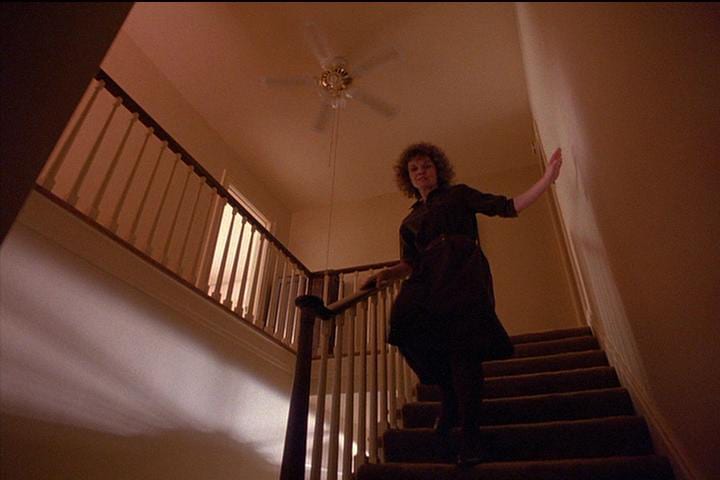
The Ceiling Fan is an official character in Twin Peaks, with a Star Pics card and everything, haunting us from a place beyond human comprehension. Many of the iconic moments in the show involve the fan, as well as its ringing and whooshing, and when we consider that even the gramophone rattling might come from this character, it’s clear we should give it some serious consideration.
The “meaning” and purpose of the portentous fan changes depending on the human interacting with it. Therefore, we’ve really got four different fans, or four faces of the one: a Sarah-Fan, a Laura-Fan, a Leland-Fan, and a Cooper-Fan. Let’s explore each of these relationships, line them up in the imagination, and create a matrix of correspondences for engaging with other Twin Peaks themes.
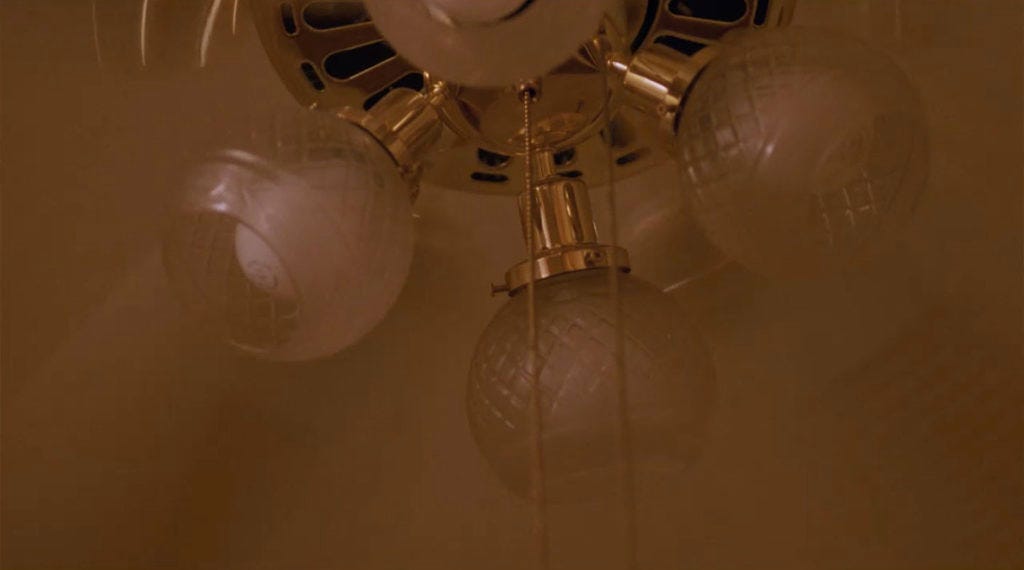
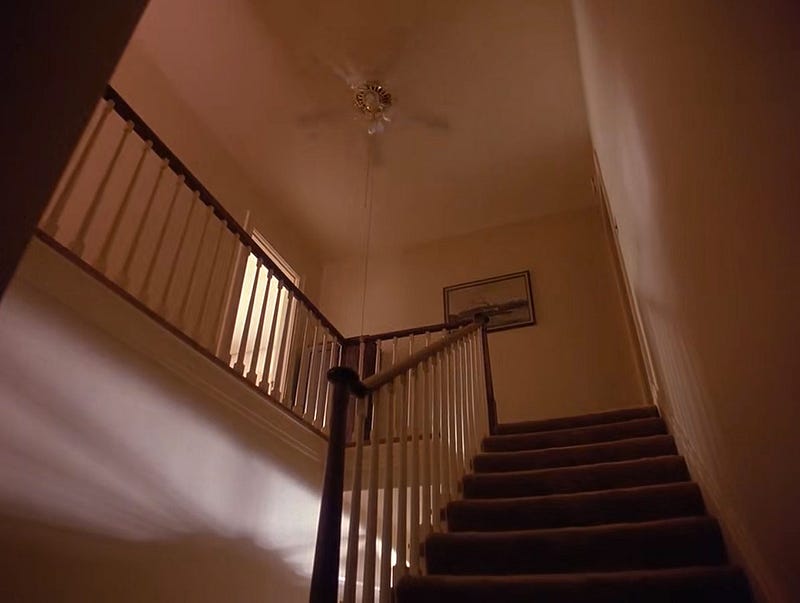
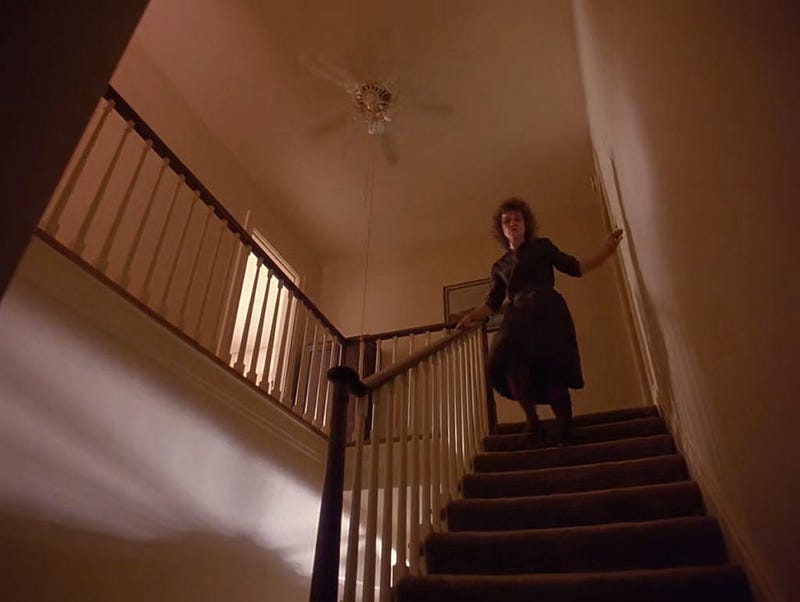
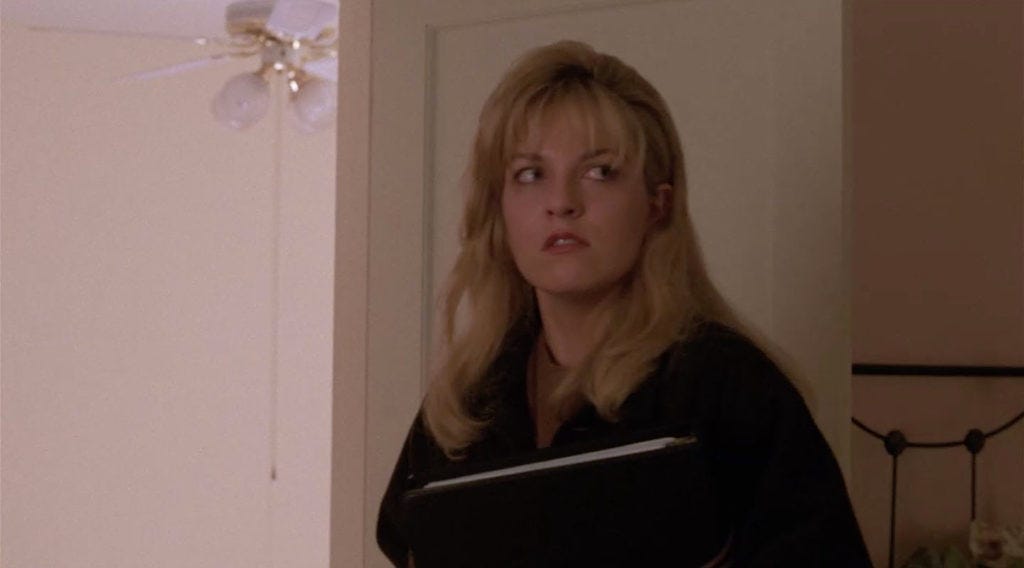
What is going on in this house?
The apex of the composition, climate controlling, energy efficient….We first notice Ceiling Fan in the background of the pilot, watching Sarah Palmer desperately search for her daughter. She calls out “Laura,” a sound bite recycled for the final word spoken in The Return. Sound studies professor Randolf Jordan (2023: 158): “In this way the closing scene of Season 3 loops back to the genesis of the show through the repetition of a sound cue.”
Not only Sarah yelling “Laura” and descending the stairs, but the ringing and whooshing are also used in dream sequences throughout the story, and there are other echoes: Season 3’s Jumping Man, with Sarah’s face projected on his, descends the stairs in a panic making distorted sounds. (Lou Ming argues this ties the two locations, the Palmer House and the Dutchman’s, together definitively). Likewise, when Maddy dies, we get a shot of the ceiling fan and Sarah descending the stairs, this time on her hands and knees. This is one of those “primal scenes” the fandom talks about: Sarah, the stairs, and the fan.

Like so many characters, Ceiling Fan also has a doppelgänger who shows up behind Maddy (one of Laura’s doppelgängers) in Season 1 Episode 6! The blonde turns brunette! Is this a continuity error or a hidden intention?
When interpreting the symbol, TP scholars (Lavery, 1995; Olsen, 2008; Boulègue and Hayes, 2013; Martin, 2014; Bushman and Smith, 2016; Hoffman and Grace, 2017; Hallam, 2018; Weinstock, 2023) connect the fan to copious circle imagery, like the ring of sycamore trees; the “golden circle” of appetite and satisfaction Phillip Gerard talks about; the record player skipping before Maddy’s death; the Fireman’s gramophone; the Rancho Rosa logo; Josie’s door knob; the hole in the Pink Room ceiling; coffee cups; saw blades; wedding rings; flashlight rings; rings of candles; and the circular nature of incest and abuse. After watching Season 3, the spinning fan now resembles a spinning portal, like the one Gordon Cole sees connected to the stairs.
When turned off, the five blades resemble a person falling through space, or someone getting drawn and quartered. Each blade looks like a sycamore tree seed that spins like a helicopter. You know the one.
The fan is also someone turning on and off. Leland? Sarah? Laura? Cooper? Hayes suggests the low and heavy ‘whomp whomp’ alongside views of the fan from below are an allusion to Laura’s rape. Olsen highlights the fan’s counter-clockwise rotation, and how Leland holds Laura’s picture and dances in a counter-clockwise rotation.
On top of all this, the fan is something hanging over everyone’s head: a metaphor for the abuse, and for the masks.
It’s not simply connected to any one of these, but to all of them, and none of them, like the everything bagel in Everything Everywhere All At Once.
Sarah
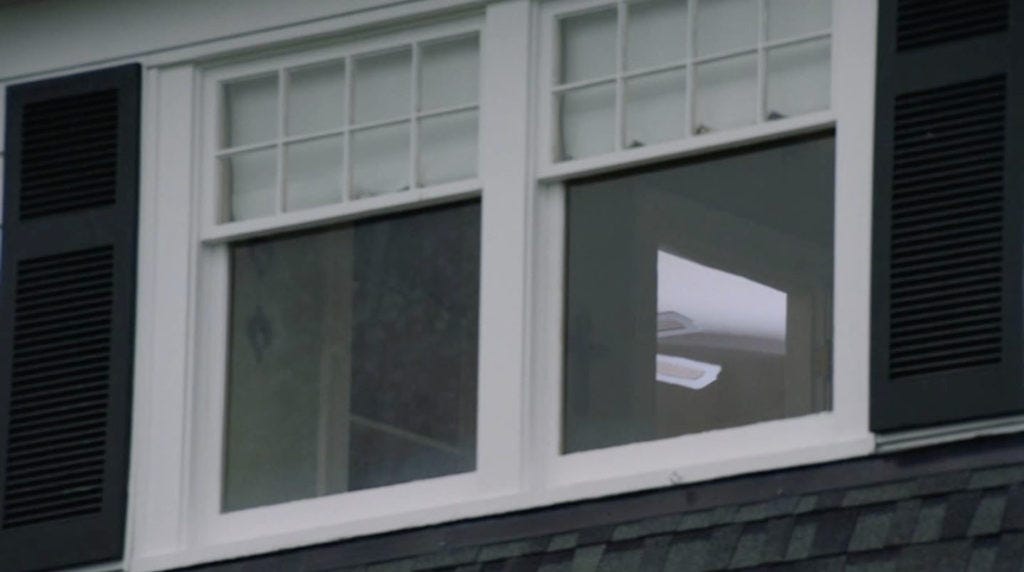
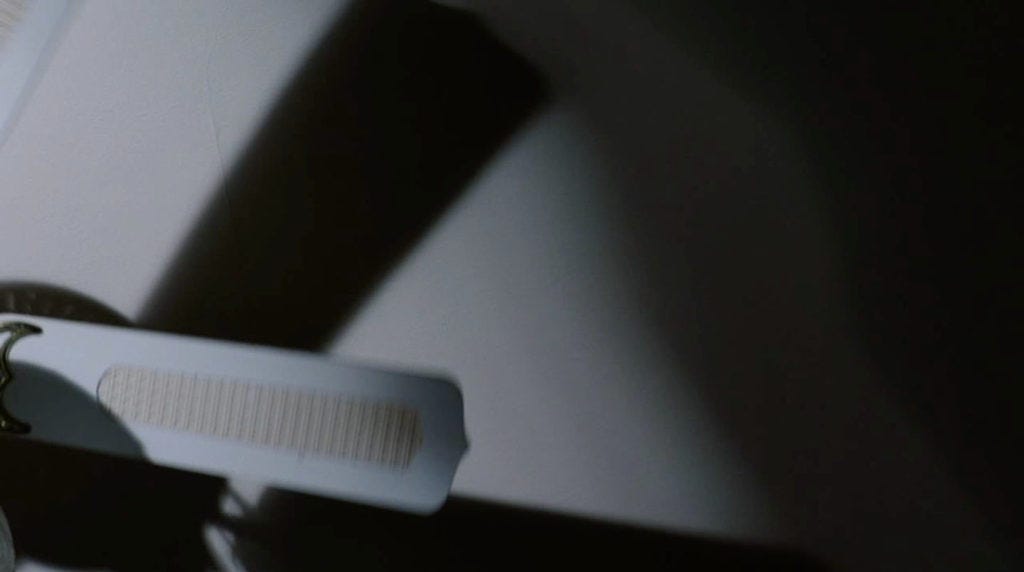
Fast forward or rewind to Season 3 Part 12, when Hawk checks on Sarah after the incident at the grocery store. We get two new shots of the fan, the first and last shots of it in Season 3 (before we go back to FWWM): one through Laura’s bedroom doorway from outside the window—Leland/BOB’s view? A new Doorway Picture!?—and the other from directly beneath it. Notice this new shot focuses on the shadow of the fan more than the fan itself, pointing to other themes in the mythos: shadows; everyone being half-there; that we fans will have to complete the image ourselves; that we ultimately can never return; unrelenting newness.
Ceiling Fan leads us back into the house, and then into Sarah Palmer answering the front door: “Hawk.” We’re here because Hawk is responding to Sarah’s PTSD incident. One way to understand Sarah’s behavior is through the lens of PTSD. When she slipped out of time and struggled to stay in control of her mind and body, she was triggered. John Thorne (2022: 188) thinks she starts talking to Laura, telling the teenage clerk, who looks a lot like Laura, “Your room seems different.” And then she warns her, “Men are coming!” Thorne believes the tragedies of Sarah’s life are blurring. “She may be warning Laura of threatening men, but she fears a more imminent threat. Struggling against an interior evil, Sarah’s identity wavers. ‘Something happened to me!’ she cries.”
Reminiscence Triggers
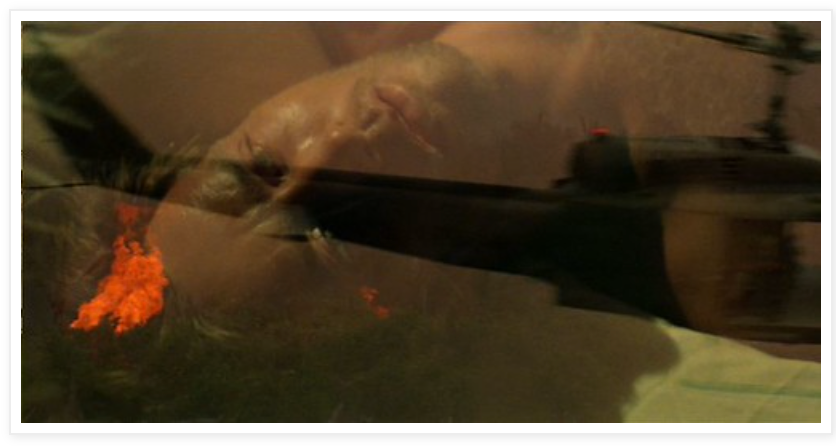
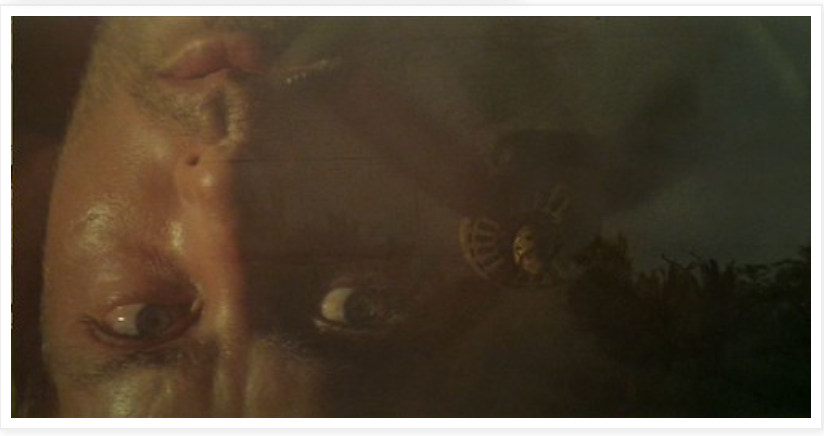
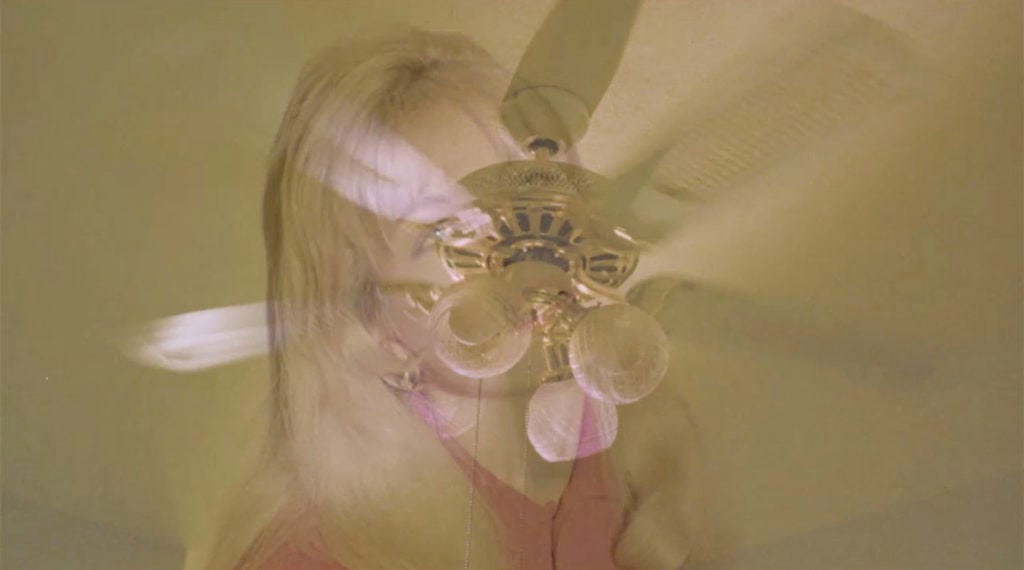
Ghosts cling to the present. Francis Coppola explores PTSD experience in Apocalypse Now (1979) through a ceiling fan. The opening scene overlays spinning helicopter blades and fire bombings in Vietnam with spinning fan blades in Willard’s apartment, all happening within his upside-down semi-transparent floating head. “The End” by The Doors plays in the background.
For a person suffering from PTSD like Willard, or, as we can imagine, Sarah, Laura, Leland, or Cooper, the fan triggers a memory, a re-membering, so that time folds in on itself. Is it future or is it past? What is memory? What is dreaming? This doesn’t only happen with PTSD flashbacks: William James, in The Principles of Psychology, describes this aspect of consciousness as a “blooming buzzing confusion,” theoretically present in infants, when time and causality aren’t quite straightened out yet.
Cooper
Flashbacks are a form of time travel. Ceiling Fan loosely connects to the Philip Jeffrey Figure 8 through these currents, as well as to Agent Cooper’s psychology. He dreams of the ceiling fan in Seasons 1 and 2, and at the end of Season 3. The fan’s whooshing takes him back to FWWM. Right after Phillip Gerard—whose face interchanges with Cooper’s at the doorway in the ringing basement of the Great Northern, wtf?—as soon as he says Electricity, Cooper freezes (like Chet Desmond) and then we hear, as we drift into Coop’s sleeping face, the fan palpitating like a heartbeat. Cooper fades to black (again like Desmond), and then we see the fan! It looks like the same shot from Part 12, with the strong chiaroscuro.
We travel back to FWWM through the electricity in the ceiling fan down into… Leland? Did he just turn it on? Is this his POV, watching Laura run to James? They pull the rug out from under us, again: is Cooper, Leland? See Tim Kreider’s theory “But Who Is The Dreamer?” for some unsettling news. (Spoiler: Laura screams when she sees Cooper in the woods because she sees her rapist). No one is permanent. There is nowhere to stand. There is nowhere not to stand.
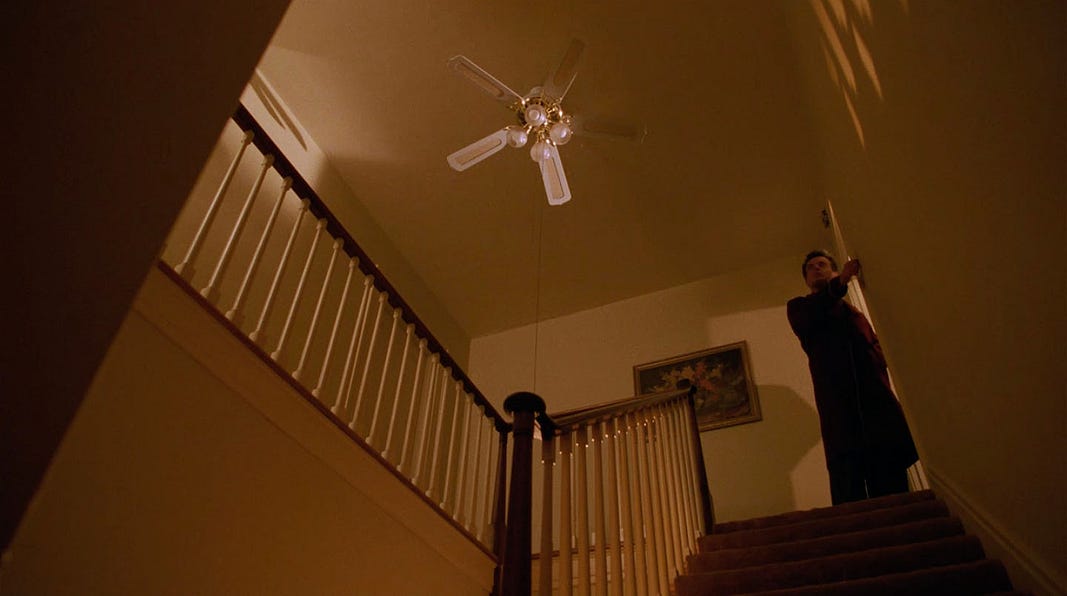
“You can go in now.”
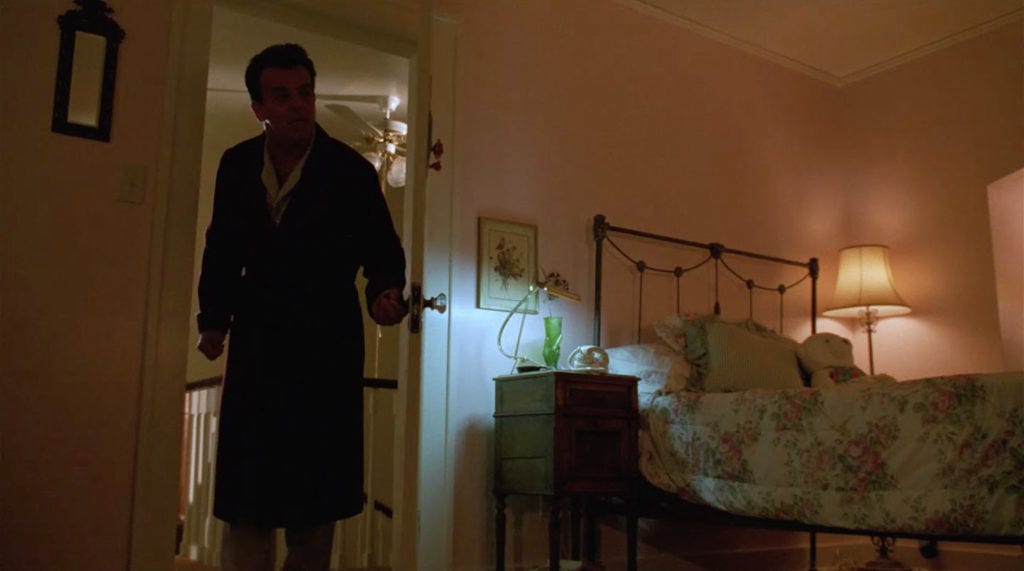
This scene from FWWM, of Leland at the top of the stairs, resembles one in Part 15, when a Woodsman at the top of the stairs, with a record player, must turn the electricity on so that Mr. C can pass through the threshold to the Dutchman’s. Interestingly, the Dutchman’s is also the motel where Leland used to have sex with Teresa Banks, and almost had sex with Laura and Ronette. When we layer these three scenes, the long corridor Mr. C walks through to get to the motel is the hallway Leland walks through to get to Laura’s room. The young boy in a mask jumps around in circles.
In any case, for BOB/Leland, the fan starts the ritual. Why must he turn it on? Maybe it somewhat covers up the noise he and Laura make, or it helps dissipate the smell of engine oil that accompanies BOB’s appearance. Yet, Sarah is passed out anyway, and he’s not hiding from Laura, so there could be other reasons.
For Leland, the serial killer and rapist, electricity and whooshing means he can go in now. Flipping it on is part of the ritual, an “outward expression of an inward state.” From this perspective, when Laura’s father is standing beneath the fan, about to turn it on, he’s at a threshold, and makes a decision. The fan above the stairs physically and psychologically hangs between Sarah’s bed and Laura’s. He turns it on. The world spins, and the “vertical axis of father-daughter relationship moves to a horizontal line of lovers” (Hallam, 2018; Martin, 2014). Therefore, the electric fan becomes “the point of maximum tension” in this home, as Martin puts it, who also thinks the fan is a symbol for abuse and its aftershocks, “wafting domestic corruption into each home in the town.”

“THE FAN COMES TO LIFE.”
“THE FAN’S POV” is mentioned in the Fire Walk With Me script (excerpts provided by Redditor IAmDeadYetILive). Materialists would say that when we flip the figure-ground relationships and decenter the human, the switch on the wall tells Leland’s fingers exactly where to go, how much pressure to apply, and then the electric fan itself plays host and elixir to the horrific ritual acts. Agency might not exist in the lifeless fan, but it’s not in Leland, either. “Agency” emerges out of the interaction between the two.
About the whooshing, someone online wrote: “It’s like the inverse of birds chirping, it’s an auditory presence that doesn’t let you forget it exists, when so many people go to such great lengths to cover it up and hide it, Lynch gives it a voice, as it were.” Another fan points out that the whooshing can be heard when Cooper and Diane “cross” in their car, connecting Diane to the fan as well. “There is context between Cooper/Mr. C and the whooshing that links their relationship to Laura’s, Sarah’s and Lelands: Diane was raped by Mr C, like Leland raped Laura; Sarah was/is complicit, like Diane helps Mr C.; Diane is tormented by the memory, just like Sarah.”
“Faster and faster.”
During the opening credits of Season 3, the zig-zag floor spins as if we are in the POV of a ceiling fan, and it’s spooky that Laura, in Part 1, looks up, screams, and then is sucked up into the ceiling.
We should remember that for Laura, night after night, year after year, from her bed, she’d hear the fan turn on, maybe even hear the click of the pull cord, and know to get ready for BOB to crawl in through the window. The whooshing, ringing, and clicking fan was the soundscape for abuse for years. In The Missing Pieces (2014), she has an experience beneath the Fan, when she whisper-screams “No!” and then is pulled into a trance. A grin stretches across her face in slow motion, the camera doesn’t cut away (like a Bill Viola film or Butoh performance). The fan blades are spinning, ringing, and whooshing, while her pupils dilate as we hear BOB hiss, “I want to taste through your mouth…”
Studies show that ceiling fans can make people hallucinate, and they can make people hear things, but this scene takes audio pareidolia and “Musical Ear Syndrome” to a whole new level. This is the first time we’ve heard BOB’s voice come from the fan. He usually speaks to Laura through the diary while she’s writing. (BOB writes in all-caps). Does Laura channel BOB’s voice through the fan? She appears to be enjoying it, and we should remember that Laura told Dr. Jacoby in a tape that she sometimes got off when BOB tried to kill her. “Isn’t sex strange?”
If Leland is the ceiling fan, then this scene from The Missing Pieces is the rape scene, edited as a memory or dream-sequence that overtakes Laura on the stairs. Her mother, with a cigarette in her mouth (see Jumping Man’s nose) interrupts her trance/PTSD experience/blooming buzzing confusion/demonic possession by calling out “Laura?”
Like the stoplight above, the flashing UFO light in the corner of her room, or even the literal angel who appears at the end, Laura’s mind and the ceiling fan blend together. This is a very specific circumstance Lynch/Frost crafts for us, but the principle is fairly common. People disassociate. John Thorne, in Lost in the Movies, reminds us that The Missing Pieces is “2014 Lynch dealing with 1992 Lynch.” He’s got Inland Empire, Lost Highway, and Mulholland Drive in him, and he’s starting to set up Season 3 and the celestial rug to pull out from the story forever.
“Listen to the sounds.”
Eli Hathaway thinks the sounds we hear from the Fireman’s gramophone in Part 1 could be a rattling ceiling fan. “Of course with some editing.” The rattle from the motor is isolated and slowed down, or is it sped up? It also sounds a lot like the pull cord (Steven Miller points out that we see the pull cord in Laura’s Doorway Picture dream). Some people think the sound could be, like Jumping Man’s squeaks, a phrase sped up, and they can hear, “This is your name now.” Others claim it’s the woodsman poem. Still others think the sounds are from a rotary phone, a Geiger Counter, the keys to the diary, Audrey twisting a pencil into the styrofoam coffee cup, a reference to the Palmer record player skipping at Maddy’s death, and more. What’s your favorite theory?
We infer Laura listened to the sounds of the fan to dissociate. The ringing, whooshing and rattling soundscape facilitated a psychic release from her body. (What are they doing in Agent Cooper’s dream?)
The fan is a host and angel, a presence that stayed with her through the whole thing. Tangentially, ceiling fans are some of the first images a human baby perceives or becomes aware of — our first friends. (In a sense, they’re placental.) Susan Brink, author of The Fourth Trimester (2013) emphasizes that it’s the bold contrast between the fan and the wall — the figure and the ground — that babies are drawn to. Babies are also looking up all the time. The Ceiling is home. (We’re all fans of ceilings, lol). Lakoff and Johnson, in The Metaphors We Live By (1980) remind us that the fan is “up;” Mother is up; Mother picks us up; Father picks us up.
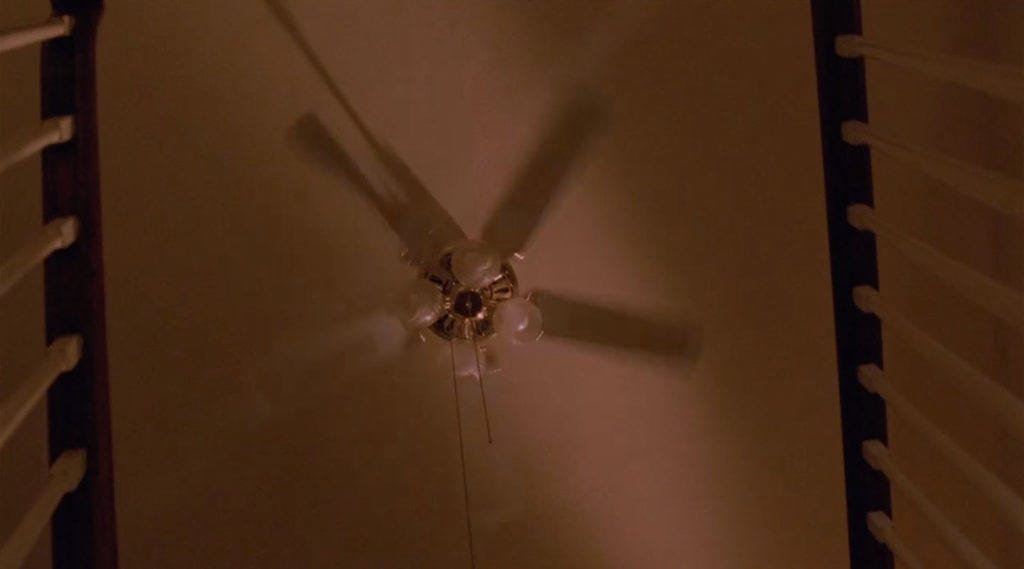
In the Secret Diary, we read how, when Laura was a little girl, BOB would pick her up and then take her into the hall, down the stairs and out the front door to rape her in the woods. She says she thought her parents must know BOB, because why else would they let him come into their house, making so much noise? It’s heartbreaking.
Here are three hours of the ceiling fan ringing and whooshing. It’s the ringing that permeates the Great Northern, the same ringing The Arm makes during his introduction in Season 1 when he rubs his hands together, “like the ringing of a monastery bell,” according to Ben Horne. Yikes. In the Great Northern, and in Twin Peaks, neither the ring nor the ringing is easily locatable, but if we begin to line the ringing up with the fan, interesting things happen in the narrative.

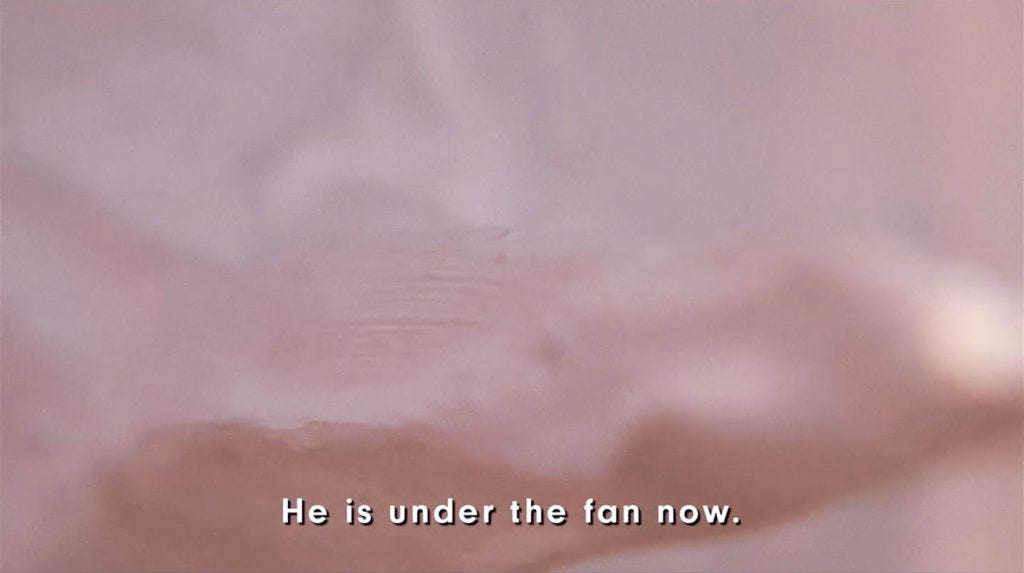
In FWWM, Pierre Tremond, the boy behind the Jumping Man mask, relays the message to Laura that “He is under the fan now.” Coincidentally, the close-up shot of the boy’s nose looks like an abstract image of the fan blade. Pierre is also seen jumping around in circles by Leland in the motel parking lot.
Why do the boy and grandmother relay this message to Laura? Do they want her to go home and get raped again, or to avoid the house? I don’t think it’s to harm her, do you? However, the fact that the boy is dressed like Leland is pretty spooky (did BOB send them from the lodge to get Laura so he/Leland could have a quickie during lunch?). More likely, Pierre is warning her that if she wants to know who the man behind the mask is, she should go home now and look. (“And by the way, I look like your dad, hint, hint, and probably am his adolescent version separated from his body when he was getting raped by Robertson).
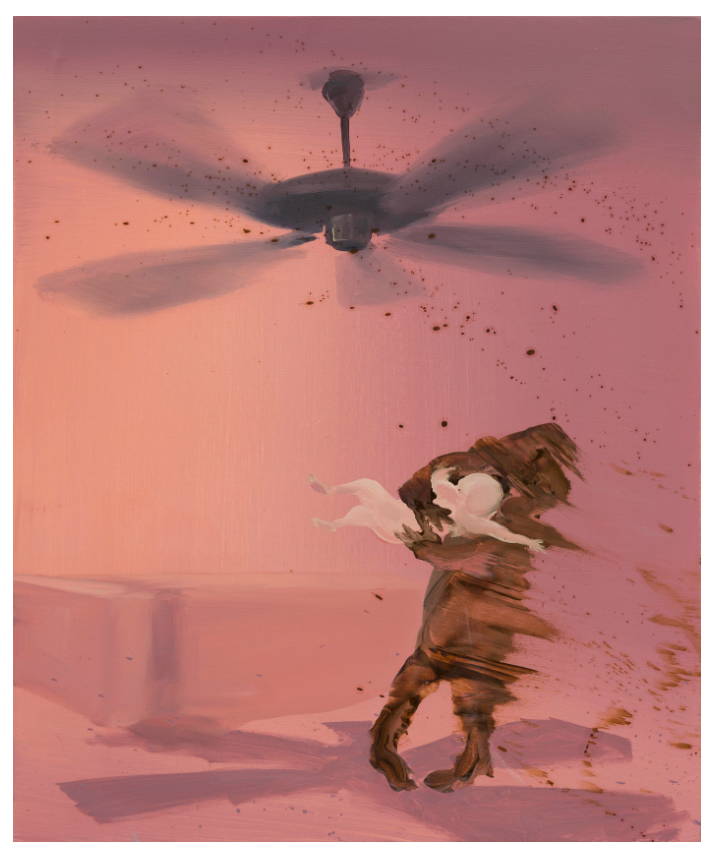
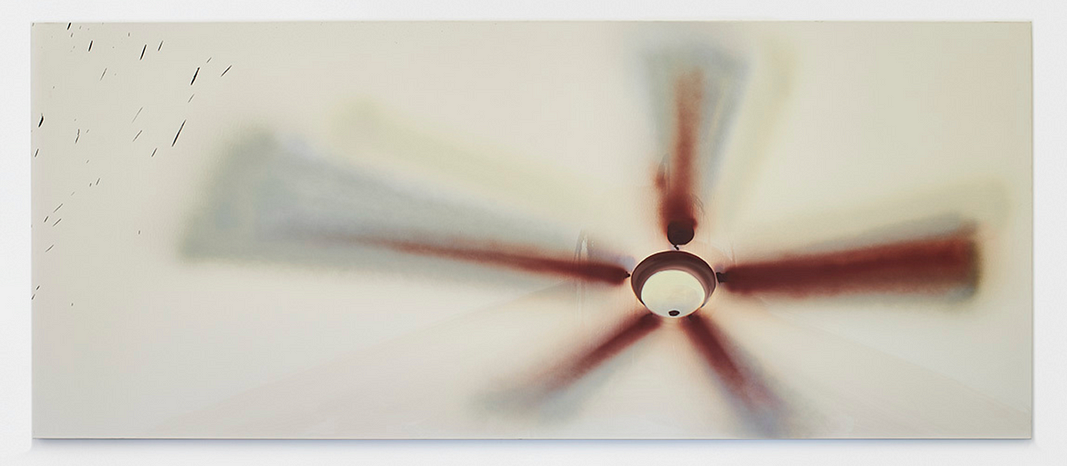
Death Fan
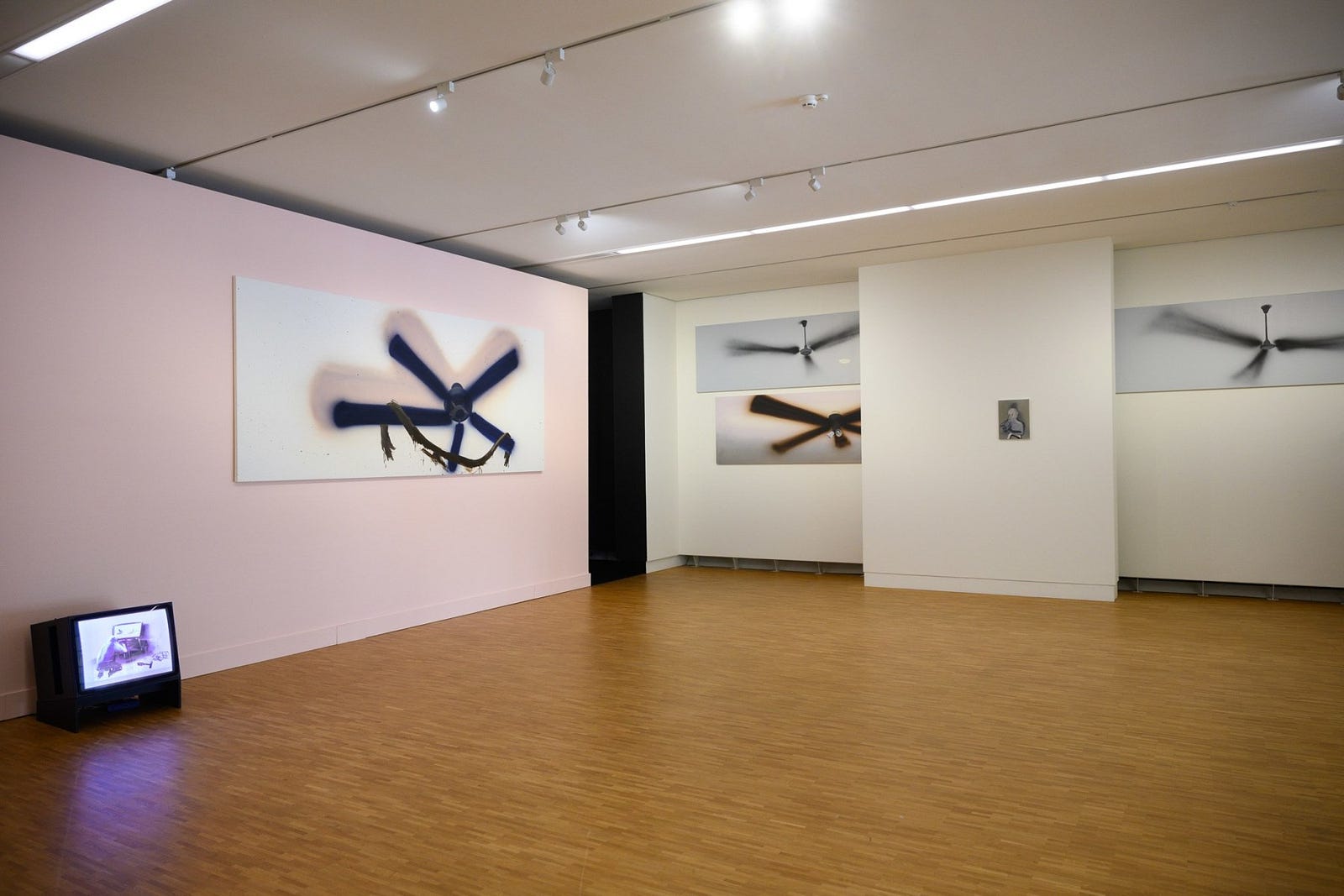
Iranian artist Tala Madani provides more insight into ceiling fan imagery, as she paints them along with her famous Shit Mothers. See Death Fan, or another one called Climate Control. Madani’s ceiling fans splatter shit everywhere, and have blades that slice through the air like knives. She says fans give us the opportunity to re-examine the air as a new site for dread.
Air is thick and filled with shit. The fan and its sounds capture Leland and Laura’s inner lives, mixes them, inflames them. Considering auralism and sound fetishes, the psychology of PTSD, and serial killer rituals, the fan takes on a more active role.
Killer Houses
The camera lingers a bit too long on the fan. The domestic becomes wild, the familiar becomes alien, the home becomes a living, malignant force. It plays into the haunted house trope, and connects Twin Peaks to killer houses, living houses, and houses that drive people mad.
The killer house is a kind of traditional American monster, as Adam Jortner puts it in American Monsters (2021). The late 19th century woman driven mad by her yellow wallpaper echoes into the urban legend of the babysitter who traces the prank call, only to find out it’s coming from inside the house! Likewise, Jortner explores Edgar Allen Poe’s Fall of the House of Usher next to the 1973 novel Burnt Offerings, which is about a house that feeds off the physical and emotional pain of the people who live there. As the woman’s family disintegrates, she spends more time caring for the house, who seems to love her more than her family does.
There were a bunch of ‘evil house’ stories in the 1970s, like The Shining and The Amityville Horror, and Jortner thinks this is related to the ’70s housing crisis, because when houses become too expensive, they own you, not the other way around. People rushed to see movies and consume stories about evil houses because monster movies alleviate cultural anxieties “like pressure valves.”
The Palmer House is haunted by ghosts and, evidently, by another house with floral wallpaper. The fan, like the Doorway Picture, could be a portal between the two houses. The stairs in the ghost house are decorated with a large painting of a mushroom cloud, connecting the Palmer House situation to the Trinity bomb. Dirty bearded men stand on the stairs presumably beneath the lodge ceiling fan, blowing their excreta throughout the house, throughout the world. Are they waiting for Gordon Cole, or do they just hang out on the stairs all day, under the fan?
These are stories about monsters hiding inside houses. Ceiling fans are a fixture in 80% of US homes. Turning our attention to them is an artistic strategy, where, as Marshal McLuhan put it, “The previous environment becomes a work of art in the new invisible environment.” It’s also a filmic choice. Youtuber Alex Thebold says he’s been paying attention to ceiling fans in movies since he was a kid. He’s edited together some classics, and the Roadhouse (1989) scenes, in Part 1 and Part 2, resemble iconic scenes from Twin Peaks! It’s striking how ceiling fans were associated with factories and public places like bowling allies before they ever moved into private homes. The fan in Twin Peaks can likewise be a sign that the private house is more factory-like than we’d like to think.
A German-American inventor, Philip Diehl, made the first electrically powered ceiling fan in 1887 by mounting blades on a sewing machine motor. He even attached a light. It’s an assisted readymade, born/patented in 1889, the same year the Curies discovered radioactive material and neon was distilled from pure air and trapped in a lamp. The fans we know and love wouldn’t fill US homes until the 1950s, and then they dip in popularity, only to resurge in the ’90s.
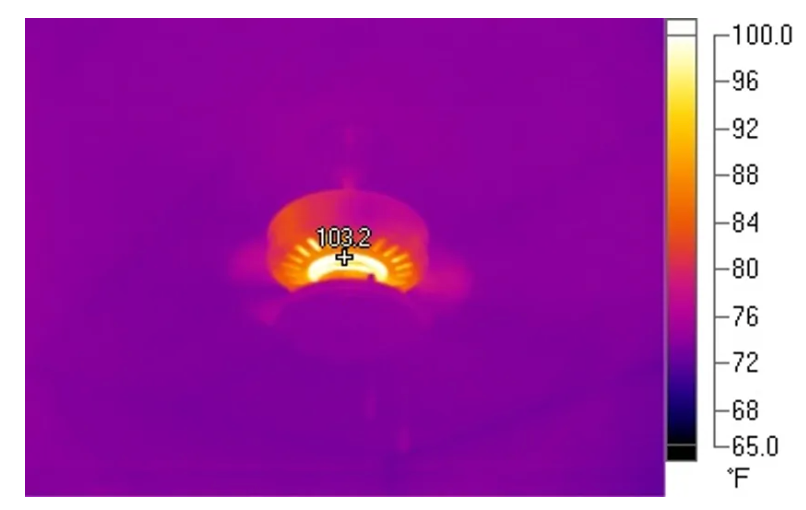
It has become a symbol for lowering energy cost, yet evidently most people don’t adjust their thermostats when using ceiling fans, and so they actually increase their energy use rather than reduce it. Whoops! The motor also generates more heat! See Ceiling Fans are Evil.
God, imagine Leland turning on the fan to “save on energy costs.”
Conclusion
The fan reveals a marvelous system of correspondences, between fathers and record players, rings and rings, mothers and helicopters and PTSD. Probing this character encourages metaphorical thinking, slow thinking, and the building of a chord and a theme. Its sounds are an escape for Laura, its electricity a catalyst for Leland, its image a reminder for Sarah, and we don’t know what it is for Cooper, but it’s something. When we leave the literal story and enter myth, that ominous fan in Twin Peaks is a reminder that above us in the food chain are angels who feast on our pain and suffering, and there is a spinning blade of fire that keeps some locked in a cycle of trauma.