Jean Jentilet
Released into the crowded horror landscape of the early 1970s, the original Black Christmas was a signal of what was to come, the subgenre that would dominate the next two decades: the slasher. Black Christmas helped codify many familiar tropes that would be used for years (and are still used today), but its treatment of feminine power in the face of danger (of which the Final Girl is the most famous manifestation) is the most interesting and complex. The 1974 (Bob Clark) original and two re-imaginings in 2006 (Glen Morgan) and 2019 (Sophia Takal), each decidedly a product of its time, present three visions of the contemporary condition of feminine power in the particularly salient setting of a sorority house under attack.
Each version of Black Christmas exists apart from each other version. Each represents a clear and distinct version of the story it is telling, and while none require conversation with any of the others in order to be appreciated, such conversation does add a substantial layer to that appreciation. Clark’s is a straight-forward, giallo-flavored murder mystery-thriller set in a sorority house; using the structure of the original, Morgan presents a garish but fun slasher, an homage acutely aware of its history and choosing to deconstruct itself by leaning in; Takal’s entry, suffering from its PG-13 stamp, strips the metaphor off its predecessors to present in big gestures and no uncertain terms a discussion of feminine power as an antidote to corrosive systems. Each film, first and foremost, uses the imagery of the sorority itself to stand in for solidarity more broadly.

Of course, horror movie wisdom is that leaving the group is death. This usually takes the form of people who find themselves in the same unfortunate place for some shared purpose: camp counseling, a cross-country trip, or simply attending the same high school. The sororities in Black Christmas represent bonds more dynamic and more firmly grounded than happenstance; there is shared purpose, but that shared purpose is both based on and becomes a shared identity. All three films begin with a single sister putting herself apart from the sorority in a deliberate way, thus setting off the action. Clare Harrison (74) leaves her Pi Kappa Sigma sisters to start packing early for her holiday visit with her family after being upset with sister Barb’s brash response to unsettling phone calls from “The Moaner.” While Clair Crosby (06) has no bad blood with any other Delta Alpha Kappas, she does have an estranged sister (Leigh) that she is planning to reconnect with, and has shut herself in her room to prepare for the moment. So there is explicit tension among the sisters at PKS, while the separation at DAK isn’t about any particular Delta, but is about prioritizing blood over other bonds. At Mu Kappa Epsilon in 2019, there is no insinuation of a rift between Lindsay and the other Mus. She is away from them and the house when she is killed. At key points in each movie, there is a digging in, a refusal to abandon each other as sisters (some variant of “I’m not leaving without my sisters” appears in each movie). Takal uses the same idea with the murder of Marty’s boyfriend, Nate. When he seems out of nowhere to engage in a sort of contrarian aggressiveness while the Mus are trying to reinforce their own unity, Marty kicks him out of the house. When he tries to return later, apologizing for his behavior (sincerely or not), he is killed almost immediately. This isn’t, as Takal later shows, about him being a man; it is about the fact that he was a threat to the unity itself, had demonstrated his willingness to leave when it mattered, and in doing so made himself vulnerable. Morgan puts a finer point on this: Clair’s sister Leigh, a former Delta herself, comes back to the house after fifteen years to reunite with her biological sister, and refuses to leave without her (or any of the other Deltas). In the end, it is her refusal to leave that saves sole survivor Kelli. At the same time, Mrs. Mac and Heather, when given the option to stay with the rest of the Deltas to find Clair, instead decide to seek help elsewhere. They are dispatched before they can even leave the driveway—Heather by Billy, and Mrs. Mac (in a nod to A Christmas Story) by a rogue icicle. As Heather throughout the movie held herself above her sisters, her death made it clear that Billy saw no difference in the women. Mrs. Mac, having taken on the role of housemother and then abandoning it, is symbolically punished by the house itself which, as discussed below, serves as the locus of strength and power that the conflict at the heart of each film centers on.
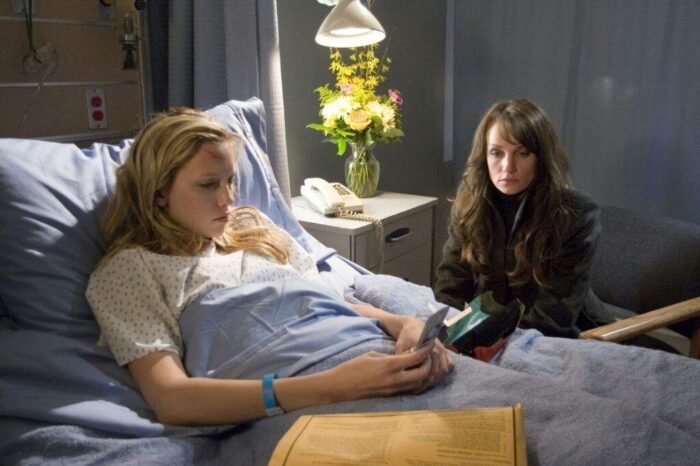
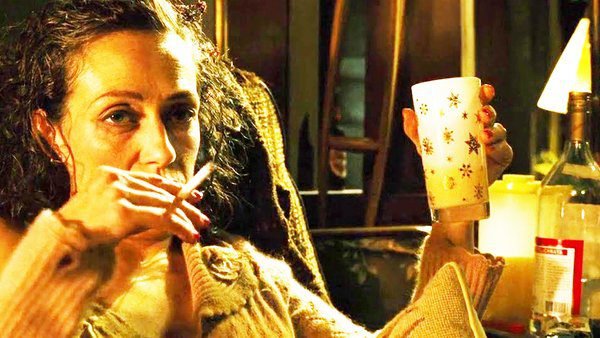
There are four mothers in the Black Christmas universe and given the conception of the sororities as a family unit, they are worth discussing as they each model different perceptions of motherhood. In 1974, house mother Mrs. MacHenry is a keeper of secrets, constantly nipping at bottles hidden in cabinets and toilet tanks. Her main concern when Clare’s father arrives at PKS looking for his daughter is hiding vaguely suggestive posters from his view and maintaining his belief in his daughter’s good behavior. She’s a realist, of course—she knows what the sisters get up to, especially Barb, and has no judgment for them even as she tries to gently corral them. We are pointedly shown evidence of her vaudevillian (and possibly burlesque) past. She understands the world outside of the sorority house that her charges, in their early steps of adulthood, do not fully grasp. She acts primarily as a protector of the Pi Kappas. In this way, despite her past, she feels very much like a traditional mother figure, and as such represents a conception of womanhood that her charges seem to be growing away from (in the movie, and in the larger world): in particular, Jess, whose arc is shaped by her conflict with Peter about her pregnancy and her resistance to his demands. We get a very different Mrs. Mac in 2006, played appropriately by Andrea Martin (Phyl in 1974) since this Mrs. Mac seems much more to be “one of the girls.” Unlike 1974 Mrs. MacHenry, we never see Mrs. Mac in 2006 away from the sisters; she is a part of them, almost as if she only exists by their presence. It is Mrs. Mac who insists on binding the group together through a gift exchange and sharing the story of the house’s prior tenant, Billy Lenz (and his mother). She is ultimately a sort of negligent mother, the “cool” mom that lets you stay up late then forgets about your school play—as we see when she leaves most of the Deltas to fend for themselves. The remaining Deltas react to this by banding together even more fiercely. And Lindsay’s mother in 2019 is a concerned presence on the phone but seems no more involved in her daughter’s lived life. The camaraderie we see amongst most of the Mus throughout the film would be a high contrast to this kind of relationship. The fate of the housemothers is tied up in their roles providing guidance to PKS and DAK, as caretakers of the symbolic family unit. The most central mother figure of any of the films, Constance Lenz, is more than a bad mother by every possible metric; she is the actual failure of motherhood. It’s not about that identity as a sum of its parts; it’s that she stands in opposition to every single value that a “good mother” would possess: the protection instinct (however besotted) of Mrs. MacHenry, the affection (however fleeting) of Mrs. Mac; the concern (however obligatory) of Lindsay’s mother. She is the bizarro reflection of all of these women: a mean drunk who drops broken Christmas ornaments into her child’s crib, then locks him away and forgets he exists. She is an abusive woman who creates a monster of a man. She pays the price for her failure by meeting the single most brutal end across all three movies, when her son, her own flesh and blood, destroys the family that she used to supplant his own, then bludgeons and devours her.
The sorority house itself, in any iteration, is never a safe space. Pi Kappas are only killed inside the house in Clark’s film, even as they lock themselves in and burrow themselves more deeply into its foundations. Indeed, it is the very act of surrendering in the house and in some way to the house, that is Jess’s demise. The house is essentially taken over by The Moaner. From our first glimpse of the Pi Kappa house through his eyes, we understand him as a voyeur, and this is how he achieves and maintains control within the house. Insofar as the Pi Kappas (Jess and Barb in particular) imagine themselves to be independent women, the killer reminds them that this is an illusion, that someone is always watching and always listening to make sure it doesn’t go too far.
Morgan takes the next step by making the house the actual childhood home of killers Billy and Agnes. Despite an absolute glut of eyeballs, the voyeurism in Morgan’s film is superficial. There’s no need for it. This is the invaders’ home turf, and the Deltas are there at his whim. Leigh and Kelli cannot navigate the hidden passages where the real control of the house is with the same effortlessness as Billy (and daughter/sister Agnes) can because it was not part of their upbringing. The only escape for Leigh and Kelli from his control is the house’s destruction by fire.
Takal’s Mus take the fight entirely away from their own house and into their opposite fraternity, shifting the battleground. They have removed the conflict from the structure that the powers that be at the university (standing in for a system that hurts men and women alike) had put in place for them. It is by breaking away entirely from that framing of expectations that they are more successful than their predecessors.

The motives (where they exist) of The Moaner, Billy and Professor Gelson/DKO also become more defined with each film. The Moaner, as far as the audience can tell, has no motive whatsoever. He just appears as a limiting force against a group of women coming into their own. Billy, of course, is motivated by years of abuse at the hands of his mother, but more specifically his desire to reclaim control from the women of DAK. We don’t have to guess at DKO/Gelson’s reasons. They spell it out. They are bent on controlling women, but that motive can be broken out even more. For the DKOs, it is that the Mus (and Riley specifically) have dared to complain about a pattern of rape and sexual assault that DKO engages in as a matter of course. When complaints lodged against the fraternity (and specific brothers) result in public embarrassment, the group doubles down. It’s not really about potential consequences, and it’s certainly not about sex; it is about having presumed, unearned authority challenged. Gelson exhibits the same hostility towards accountability in even its mildest forms: instead of having an open discussion with his class about why he doesn’t include works by women in his syllabus, he castigates them with a gotcha quote from Camille Paglia (a delightfully pointed choice by Takal). It is the concession by the university that these challenges may have merit, demonstrated by the moving of the Hawthorne bust, that is the final straw.

But there are other threats to the sororities, all cogs in the same machine. Across all three films, the police are some combination of indifferent and incompetent. While not an active threat, the sororities’ reliance on the police, as they’ve been raised to do, becomes a hindrance. Morgan’s police claim that they cannot get to the house for at least two hours—though presumably response time was much better after the house caught on fire (bringing to mind the old advice that if attacked on the street, yell “fire” rather than “help” because no one responds to calls for help.) In both 1974 and 2019, the sisters confront the police/campus security directly about their missing friend and are dismissed. In 1974, however, once Clare’s boyfriend, Chris, shows up at the station, the police are suddenly quite concerned with Clare’s whereabouts. In 2019, campus police are dismissive in an elaborate way: whereas Nash in 1974 seems mostly bored, the police in 2019 actually cuts Riley off, then takes her half-finished sentences to construct outlandish scenarios (or realistic scenarios framed in outlandish ways). It’s not a mere dismissal of the women’s concerns, but a dismissal of their actual perception of the world. The worst offense by the police, however, occurs at the end of 1974. They breach the house, after Jess has already dealt with a possible killer. They sedate her and put her to bed. They fill her room, elbow to elbow, talking about her and the other women—“what about the other bodies?”—as if Jess herself is a corpse, ignoring that Clare’s father is still there with them. Then they leave her to escort a single man to the hospital. The message is clear: their work is done; or rather, she has done their work for them. She is of no more consequence to them.
This isn’t to downplay the active threats to the sororities, and individual sisters. It’s no coincidence that Peter, for example, on the telephone and sneaking into the house becomes indistinguishable from The Moaner in the eyes of Jess and the police; or that Kyle, like Billy and Agnes, climbs into a window to get into the house. Nate’s behavior before being kicked out of the MKE house by Marty is essentially just mimicry of the behavior of the DKOs/Gelson. The real threat to the Mus, like The Moaner’s phone calls, is from inside the house. Helena partakes in the only true treachery in any of the films. (In 2006, even Mrs. Mac’s abandonment of the Deltas was mostly motivated by fear, and we eventually learn that Megan did nothing wrong.) All of Gelson’s plans would have been for nothing, would have at best been made exponentially more difficult if not impossible without the cooperation of a woman who, by her own words (and in stunning opposition to Jess Bradford’s unwavering confidence in herself) was willing to cede control just to make things easier. She could not simply make those life choices for herself; she took action to impose those choices on her sisters. It was this breaking of solidarity that almost did the Mus in, and the reconfiguration of it that ultimately saved many of them. This is more about the system absorbing individuals and subverting their intentions.
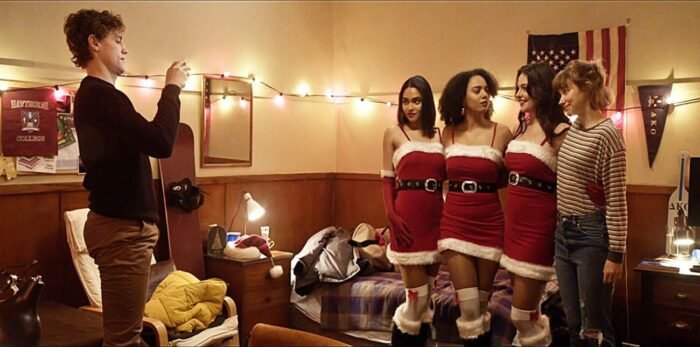
Still, even as the women are attacked for pushing unapologetically outside of expectations, they are not, despite the trope, actually punished for having sex. The Final Girl—the virginal but feisty last woman standing—doesn’t really exist in Black Christmas. Instead, Black Christmas inverts of a trope that was just starting to bloom at the time of the first film, where the first victim was, from the information the audience has, the closer to pure than any of the other Pi Kappas. Pregnant Jess makes it longer than any of her sisters even as she is harassed by her boyfriend. In 2006, Kelli (as close to a proper Final Girl as the movies get) is no paragon of purity, but she has been sexually humiliated by her boyfriend; and Riley in 2019 has been raped by a DKA. It is not some nebulous, rarified purity that marks these women as worthy. In the end, it is their choice to reclaim their dignity from a system that they cannot always see from the inside that keeps them alive.